
The Škoda Kodiaq is one of those SUVs that does not enter the room shouting, flexing, or wearing unnecessary gold chains. It walks in calmly, wearing a tailored European suit, carrying seven people, several suitcases, two wireless phones on charge, and possibly a picnic basket full of excellent decisions. This is the Czech crossover SUV that was first launched in 2016, and what we have here is the 2026 second-generation model — more polished, more premium, more intelligent, and generally more “I have matured, but I still know how to overtake a hatchback with dignity.”
And yes, the name Kodiaq comes from the Kodiak bear of Alaska. That explains a lot. It is big, strong, family-friendly in the right mood, and if provoked on the highway, can move surprisingly quickly for something this large.
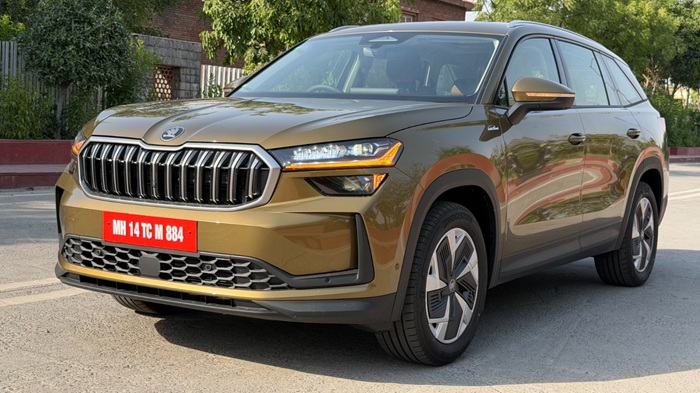
This particular model is the top-spec Selection L&K ADAS variant. L&K, of course, stands for Laurin & Klement, Škoda’s premium trim line named after the company’s founders. In simple terms, this is the Kodiaq wearing its best blazer, polished shoes, and that confident expression usually seen on people who know the hotel valet will park their car near the entrance.
In India, the Kodiaq is offered with a petrol engine only. The range starts at around ₹37 lakh ex-showroom, while the top model goes up to around ₹47 lakh ex-showroom. A more powerful Kodiaq vRS is also under testing and is expected to arrive later, which should make family duties feel a little more Nürburgring and a little less school run.
Škoda also offers a reassuring package with the Kodiaq: 4 years or 1 lakh km warranty, 4 years roadside assistance, and 4 free services. That means the ownership experience has been designed not just for people who love driving, but also for people who like sleeping peacefully at night.
The Kodiaq is available as a 7-seater, and there is also a 5-seater option. So whether your life includes children, parents, friends, luggage, camera gear, golf clubs, or simply the emotional need to buy a large SUV, Škoda has thought about it.
Globally, the Kodiaq has become a strong success story, selling roughly one lakh units every year. That is impressive for a car that behaves less like a flashy social media influencer and more like a well-educated European professor who also happens to own hiking boots.
Design-wise, the second-generation Kodiaq looks properly grown-up. The front grille gets a horizontal light strip, giving the SUV a more modern and confident face. It is not trying to scare people unnecessarily, but it does have that premium “move aside politely” road presence.
The LED Matrix headlights are a major highlight. They come with adaptive front lighting, welcome effect, coloured crystalline elements, and cornering function. In short, the headlamps are clever enough to illuminate the road without blinding others, which is always appreciated by everyone except people who think high beam is a personality trait.
From the side, the Kodiaq carries a clean, stretched silhouette. It measures around 4.7 metres in length, 1.8 metres in width, and 1.7 metres in height. The proportions are large enough to look substantial, but not so huge that every parking basement feels like a diplomatic negotiation. Ground clearance is 155 mm, kerb weight is 1,825 kg, and gross weight is 2,420 kg. It can also tow up to 2,350 kg, which means if your weekend plans involve pulling something big, the Kodiaq is ready. Trailer, boat, ego — all manageable.
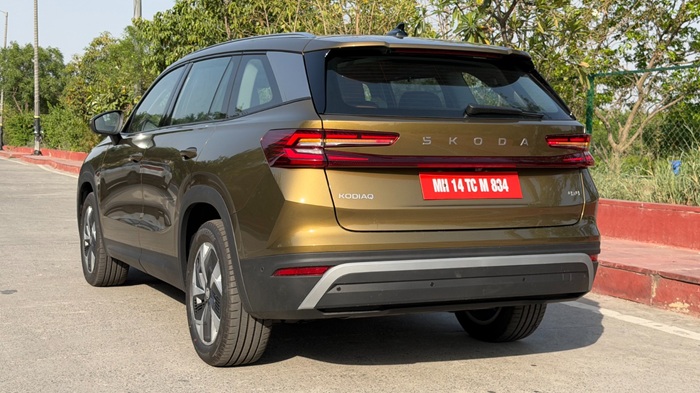
This car is finished in Bronx Gold metallic, a colour that looks classy without becoming loud. It gives the Kodiaq a rich, slightly adventurous tone, like an executive who secretly enjoys camping. Other colour options include blue, black, grey, and white. Red and silver, however, are not available in India, so if your heart was set on those, the bear says no.
The D-pillar gets a Dark Chrome finish, adding a nice touch of sophistication. The fenders proudly carry Laurin & Klement badging, which is Škoda’s way of reminding you that this is not the “basic family hauler” version. This is the version that has read the wine menu.
The outside mirrors are electrically adjustable, power-folding, heated, auto-dimming, and come with memory, boarding spots, turn indicators, camera, and Škoda logo projection. At this point, the mirrors have more features than some entry-level hatchbacks.
The Kodiaq sits on 18-inch Mazeno alloy wheels with aero trims. There are two more wheel design options as well. The tyres are 235/55 R18 Bridgestone Alenza Enliten radial tubeless tyres, and disc brakes are provided at both front and rear. It also gets acoustic side windows at the front, additional acoustic insulation, and a generally quiet cabin experience. This is the kind of SUV where you can drive through city chaos and still hear the Canton sound system instead of three auto-rickshaws debating lane discipline.
At the rear, the Kodiaq gets C-shaped LED tail-lights with welcome effect and dynamic turn indicators. The lighting signature is smart, premium, and recognisably Škoda. It does not shout for attention, but it is memorable enough to make the person behind you think, “That is definitely expensive.”
The platform underneath is the Volkswagen Group MQB37 Evo architecture. This is a serious family tree. The same platform family is connected to models like the Octavia, Superb, Audi A3, Audi Q3, Audi Q6, Cupra Formentor, SEAT Leon, Volkswagen Golf, Tiguan, Tayron, Passat, Atlas, Caddy, Tavendor and more. Basically, the Kodiaq has relatives in almost every important European parking lot.
Suspension duties are handled by McPherson suspension at the front with lower triangular links and torsion stabiliser, while the rear gets a multi-element axle with longitudinal and transverse links and torsion stabiliser. That sounds technical, and it is. The result is a ride that feels composed, mature, and confident. It is not floaty, not harsh, and not confused. It simply behaves like a premium European SUV should.
There is also an underbody guard at the front, which is useful because Indian roads sometimes behave like they were designed by someone playing Minecraft on hard mode.
Powering the India-spec Kodiaq is a 2.0-litre, inline-four-cylinder, turbocharged TSI petrol engine. It produces 201 horsepower and 320 Nm of torque. The engine is paired with a 7-speed dual-clutch DSG automatic transmission, sending power through an all-wheel-drive system.
Performance is strong. The Kodiaq can accelerate from 0 to 100 km/h in 7.9 seconds, which is quick for a large family SUV. Top speed is 219 km/h, though obviously that figure is best appreciated on paper, not on Indian public roads where suddenly one tractor, two cows, and a biker carrying six mattresses may appear.
The claimed average is around 14 km/l, and the fuel tank capacity is 62 litres. With the turbo-petrol engine and DSG combination, the Kodiaq feels refined, responsive, and effortless. It does not feel like it is working hard. Press the accelerator, and the SUV moves forward with the kind of confidence usually seen in airport lounge members.
The DSG gearbox is quick and smooth, especially once the vehicle is moving. In city traffic, it behaves sensibly, and on open roads, it shifts with that typical Volkswagen Group precision. The all-wheel-drive system gives the Kodiaq strong grip and stability, especially in rain, loose surfaces, and fast corners. It does not turn the Kodiaq into a rally car, but it definitely makes it feel secure and planted.
There are six drive modes: Eco, Normal, Sport, Offroad, Snow, and Individual. Eco is for fuel-saving moods, Normal is for everyday life, Sport is for when you suddenly remember this SUV has 201 horsepower, Offroad is for rough surfaces, Snow is for slippery conditions, and Individual is for people who like personalising everything from steering weight to their coffee order.
The Kodiaq also gets Electronic Differential Lock, which optimises torque distribution for better traction and handling. There is Engine Drag Torque Control, which uses ABS to help improve grip on slippery surfaces. This is a car that does not simply move; it constantly calculates how to move better.
Safety is one of the Kodiaq’s biggest strengths. It has received 5-star safety ratings from Euro NCAP and Australasian NCAP, which is exactly the kind of news you want when buying a family SUV. In India, the equipment list is serious.
You get 9 airbags, ABS, EBD, Electronic Stability Program, traction control, ISOFIX child-seat mounts, hydraulic brake assist, driver steering recommendation, rain brake support, electronic stability braking system, multi-collision brake, Cross Differential System XDS+, Pre-Crash proactive passenger protection, Hill Start Assist, Hill Descent Control, keyless entry, and a 360-degree camera.
The ADAS package includes Front Assist, Lane Keeping Assist, Blind Spot Detection, Lane Change System, Rear Traffic Alert, and Exit Warning System. There is also Advanced Driver Attention with a drowsiness monitor, which keeps an eye on steering inputs and driving behaviour to detect fatigue. Essentially, if you start driving like your brain has gone into screensaver mode, the Kodiaq will politely ask you to wake up.
Parking is also made easier with Park Distance Control sensors at the front and rear, along with Manoeuvre Assist and Intelligent Park Assist for automatic parking. Considering the size of the SUV, this is helpful. Not everyone was born with the spatial awareness of a crane operator.
The boot is another strong area. With all three rows up, the Kodiaq offers 281 litres of luggage space. Fold the third row and it expands to 786 litres. Fold the second row as well and you get a massive 1,976 litres of space. That is not a boot anymore; that is a small studio apartment with carpeting.
You also get an 18-inch spare wheel, and the boot can be opened by simply waving your foot under the rear bumper. This is useful when your hands are full of shopping bags, luggage, or one child who has decided walking is temporarily against company policy.
One of the cleverest practical features is the automatic Door Edge Protectors. These pop out when you open the doors, protecting the edge from hitting walls or nearby cars. This is a brilliant feature for tight Indian parking spaces, where neighbouring vehicles are often parked with the precision of a dropped biscuit.
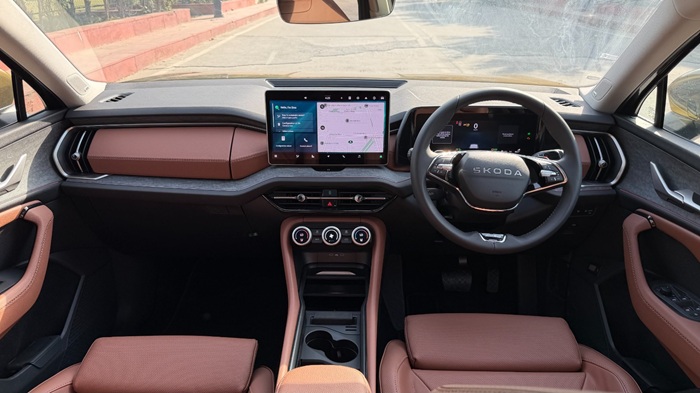
Inside, the Kodiaq is properly premium. The cabin feels spacious, elegant, and thoughtfully designed. The top variant gets brown leather upholstery, while black suede and grey fabric options are also available. Škoda has used recycled materials and eco-friendly leather, which gives the interior a modern sustainability angle without making it look like a recycled shopping bag.
The dashboard, footwell, and doors get Ambient Mood Lighting, creating a warm, premium atmosphere. It is subtle and classy, not nightclub-on-wheels. The front seats are power-adjustable ergo seats with ventilation, heating, thigh support extender, 3 memory functions, and 8 massage programs. These seats are not just seats; they are basically spa chairs with seatbelts.
The second row gets 40:20:40 split-folding seats with sliding and reclining functionality. That makes the cabin more flexible, especially when balancing passengers and luggage. The third row is best suited for children or shorter adults, but that is normal for this segment. Nobody buys a 7-seat SUV expecting third-row passengers to write poetry about legroom.
A lovely Škoda touch is the umbrella holder in the driver door. This is one of those “Simply Clever” features that makes you wonder why more cars do not have it. Rain arrives, you open the door, umbrella appears. Very civilised. Very Czech. Very “we thought of this before you did.”
There are also rolling sunblinds, anti-trap power windows, and acoustic insulation. The cabin is clearly designed for long-distance comfort. This is the kind of SUV where highway journeys feel less like travel and more like a moving business-class lounge.
The Kodiaq gets a 13-speaker, 725-watt Canton sound system with subwoofer. It sounds rich, clear, and powerful. Whether you are listening to classic rock, Bollywood, podcasts, or directions from the navigation system telling you to take the “slight left” that is actually a dramatic U-turn into chaos, the audio quality remains excellent.
A very interesting detail: the tyre pressure information is placed on the rear passenger side instead of the driver side. Škoda says, “Why follow tradition when you can confuse everyone just enough to make them talk about it?” It is unusual, but it adds character.
The dashboard’s biggest highlight is the 12.9-inch touchscreen infotainment system. It supports Wireless Apple CarPlay, Android Auto, MyŠkoda Plus App, navigation, Connectivity Dongle, USB, FM, and radio. The Lounge variant gets a smaller 10.4-inch infotainment screen. And in typical Škoda fashion, there is even a display cleaner for the infotainment screen. Because fingerprints on a large touchscreen are basically modern-day dust on a piano.
The 10.24-inch Virtual Cockpit instrument cluster is crisp and configurable. The steering wheel is a two-spoke leather multifunction unit, while Sportline variants get a three-spoke sport steering wheel. Controls are provided for volume, infotainment, voice commands, instrument cluster functions, and adaptive cruise control.
The Kodiaq also gets multi-function smart dials. These are tactile rotary controllers that can manage climate control, seat ventilation, audio settings, and drive modes. This is a clever solution because while touchscreens look modern, physical controls still feel better when driving. The Kodiaq understands that not every basic function should require a finger ballet on glass.
Climate comfort is handled by 3-zone Climatronic AC, so front and rear passengers can avoid fighting over temperature like members of a coalition government.
There are two wireless chargers, both with ventilation, which is important because wireless charging often turns phones into pocket-sized tandoors. Here, Škoda has added cooling, proving once again that the engineers were paying attention.
The cabin also gets a frameless auto-dimming rear-view mirror and a two-piece sliding panoramic sunroof with tinted glass. It brings a lot of light into the cabin and gives passengers that airy, premium SUV feeling. Children will love it. Adults will pretend not to care and then secretly open it every time.
The MyŠkoda Plus App adds connected-car convenience. Through the smartphone app, owners can access car documents, dealer locator, service booking, vehicle status, live location, geo-fencing, service history, service cost calculator, trip data, accessories, and more. Basically, your phone gets to know your Kodiaq almost as well as your family does.
On the road, the Kodiaq feels like a proper all-rounder. The turbo-petrol engine gives it strong performance, the DSG adds smoothness, and the all-wheel-drive system gives confidence. The steering is electrically assisted, light enough in the city and stable enough on highways. It is not a sports SUV, but it has enough sharpness to feel European and enough comfort to feel family-friendly.
The ride quality is composed. Bad roads are handled with maturity, and highway stability is excellent. The Kodiaq does not bounce around unnecessarily or feel nervous at speed. It has that planted, reassuring feeling that premium German and Czech SUVs are known for.
In city traffic, its size is noticeable, but the cameras, sensors, light steering, and parking assists make life easier. On highways, however, the Kodiaq feels completely at home. It cruises effortlessly, overtakes quickly, and keeps the cabin calm. This is where it shines brightest: long-distance family touring with proper comfort, strong performance, and enough boot space to move half your home.
The Kodiaq has also won several family-car awards over the years, and it is easy to see why. It is practical without being boring, premium without being flashy, powerful without being childish, and safe without needing to constantly remind you about it.
Of course, there are a few things to consider. Ground clearance of 155 mm means you should still respect large speed breakers. The third row is useful, but not limousine-like. And because India gets only the petrol engine, those looking for diesel economy may miss the old-school long-distance fuel efficiency. Internationally, the Kodiaq is also available with 6-speed DSG transmission, 2.0-litre diesel, plug-in hybrid, and 1.5-litre mild-hybrid petrol engines, but those are not available in India.
Still, judged as a premium petrol AWD family SUV, the Kodiaq makes a very strong case for itself. It is not the cheapest option, but it feels expensive in the right ways. The materials, seats, sound system, technology, safety kit, boot flexibility, and driving manners all come together beautifully.
The 2026 Škoda Kodiaq is not an SUV for people who want to make noise at traffic lights. It is for people who appreciate engineering, comfort, safety, space, and intelligent design. It is for families who travel far, professionals who like understated luxury, and enthusiasts who still want a proper engine under the bonnet instead of just a large screen and a dramatic brochure.
It is a Czech SUV named after an Alaskan bear, built on a German platform, assembled in India and the Czech Republic, filled with smart features, and powered by a punchy turbo-petrol engine. That sounds like an international business meeting, but somehow it works beautifully.
The Kodiaq is big, but not bulky. Premium, but not pretentious. Clever, but not complicated. Fast enough to entertain, comfortable enough to relax, and practical enough to justify itself to the entire family.
In short, the Škoda Kodiaq is the kind of SUV that can take your family to the mountains, your luggage to the airport, your phone to 100 percent charge, your back through an 8-program massage, and your ego through a gentle European refinement course.
It is not just a family SUV. It is a family SUV with a degree, a passport, and very good manners.