



As India accelerates towards a cleaner, multi-energy mobility future, the everyday act of refuelling is becoming increasingly complex—and often frustrating. From long queues at CNG stations to the growing maze of EV charging networks, drivers today face not just delays, but decision fatigue. The challenge is no longer just about fuel availability, but about efficiency, visibility, and smarter coordination. In this evolving landscape, the need for intelligent, data-driven solutions has never been more critical.
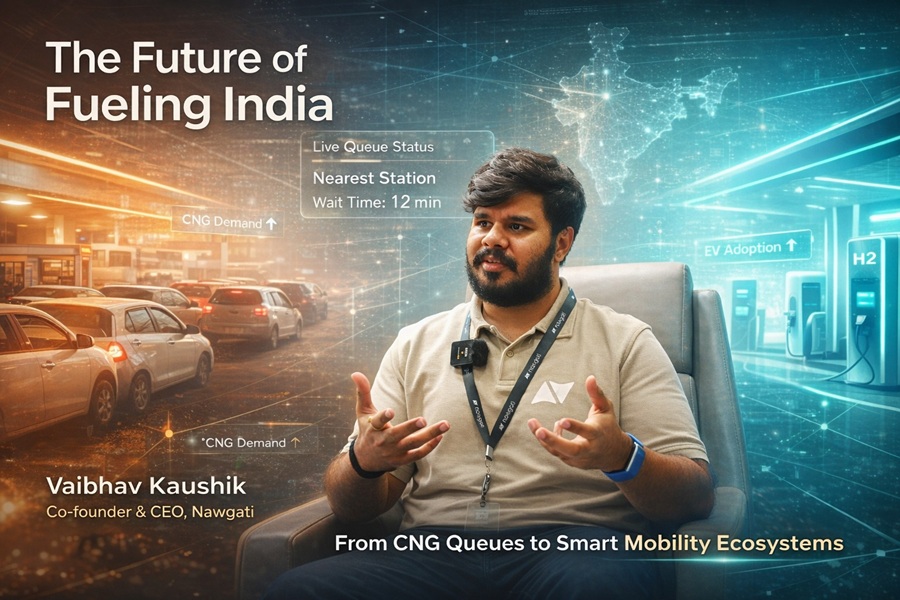
In this exclusive conversation, we speak with Vaibhav Kaushik, Co-founder and CEO of Nawgati, a startup that began by tackling CNG queue congestion and is now reimagining India’s entire fuelling ecosystem. From leveraging real-time data to building a unified, multi-energy platform, Nawgati is aiming to transform how drivers interact with fuel stations.
Kaushik shares deep insights into the root causes of congestion, the hidden economic impact of waiting in queues, and the lessons India must learn as it rapidly expands its EV infrastructure. He also outlines how technology, policy support, and smarter infrastructure planning can come together to create a seamless fuelling experience.
As India stands at the crossroads of petrol, CNG, EVs, and emerging fuels like hydrogen, this conversation explores what it will take to build a truly intelligent, efficient, and future-ready mobility ecosystem.
Q 1. Long queues at CNG stations and busy fuel pumps are a common frustration for drivers in many Indian cities. From your perspective, what are the main reasons behind this congestion problem?
At a fundamental level, the congestion we see at CNG stations is a mix of rising demand and systems that haven’t evolved fast enough to handle it. CNG adoption has picked up significantly in cities like Delhi, but infrastructure, both in terms of the number of stations and their capacity, hasn’t scaled at the same pace. On top of that, CNG refuelling is essentially slower than petrol or diesel because of the compression process, which limits how many vehicles can be served in a given time.
But what actually amplifies the problem is the lack of visibility. Drivers tend to rely on habit, meaning they go to the same stations without checking whether a shorter queue is just a few kilometres away, which leads to unnecessary clustering.
There are also very practical issues, such as station design, operational inefficiencies, and traffic flow, especially during peak hours. In many ways, it’s not just a fuel supply issue but also an information and coordination gap.
Q 2. With the rise of EV charging stations alongside CNG and traditional fuel pumps, the fuelling ecosystem is becoming more complex. How can everyday drivers easily navigate these multiple energy options?
From a driver’s point of view, especially someone who’s planning to invest in a new vehicle, it’s definitely getting more complicated. Earlier, we just had to find the nearest fuel pump. Now we are thinking, should we go for CNG, petrol, or EV? Will they be readily available? How long will they take to fuel up?
The way to simplify this isn’t by expecting users to juggle multiple apps or figure it out themselves. It has to be solved at a platform level. Much like how maps made navigation effortless, we need systems that bring all this information together in one place, allowing users to research what’s best for them and make a decision.
Ideally, a driver should just be able to see what’s nearby, how busy it is, and what makes the most sense for them in that moment, without overthinking it. Over time, this can even become smarter, suggesting options based on your route or routine.
At the end of the day, the complexity will exist in the system, but it shouldn’t be felt by the user.
Q 3. In cities like Delhi and Mumbai, CNG users often spend considerable time waiting in queues at stations. What impact does this have on driver productivity, fuel efficiency, and daily travel time?
The impact is more significant than it appears on the surface. For an individual driver, a 20–30 minute wait may seem manageable, but when you add it up across millions of users daily, it translates into a massive productivity drain.
For commercial drivers, cabs, autos, and delivery fleets, this directly affects earnings. In fact, when I started Nawgati back in 2019, the main idea behind it was to help cab drivers who lose atleast 10% of their daily earnings simply by standing in queues for CNG.
There’s also an indirect impact on fuel efficiency. Vehicles idling in queues consume fuel inefficiently and contribute to emissions, which kind of defeats the purpose of shifting to a cleaner fuel like CNG in the first place.
From a city perspective, these long queues often extend to the connecting roads, increasing congestion. So it’s not just a station-level problem; it’s an urban mobility issue. Addressing it will improve not only the user experience but also economic efficiency and environmental outcomes.
Q 4. India is rapidly expanding its EV charging infrastructure. Based on the challenges seen at CNG stations today, what lessons should the EV ecosystem learn to avoid similar congestion issues?
One clear lesson is that just adding more infrastructure isn’t enough. We’ve seen with CNG that even when stations exist, the lack of real-time visibility around wait times and availability creates congestion.
With EVs, this becomes even more important because charging takes much longer. If users don’t know whether a charger is available or how long they’ll have to wait, it creates uncertainty, and that’s where range anxiety really kicks in.
Another thing we’ve learned is how people behave. Drivers tend to go to familiar stations, even if better options exist nearby. Without the right information, demand doesn’t get distributed efficiently.
So for EVs, features like live availability, smart routing, and even slot booking will be key from the start. If we build the user experience right from the start, EVs can avoid the same inefficiencies we’re seeing today with CNG.
Q 5. Looking ahead, how do you see the fuelling and charging experience evolving for Indian drivers over the next five years?
We all talk about a data-driven future, and I do believe that’s where we’re headed, but the reality today is that most of this push is still coming from startups. With targeted efforts from startups, much of the real-time visibility into queues, availability, and station performance is being built in pockets, not at a national level.
For this to truly scale, if we get government support in creating a unified, real-time platform or directory for fuelling and charging infrastructure, adoption could accelerate significantly. It would make discovery and planning much more seamless for users across cities.
Over the next five years, the experience will gradually shift from being reactive to more planned. You won’t just stop to fuel when you’re low, but you’ll know where to go, when to go, and what to expect.
Q 6. Nawgati began as a solution for CNG queue management. Today, it is evolving into a broader fuel-aggregator platform. How has the company’s vision expanded since its early days at BITS Pilani?
Nawgati started with a very focused problem: reducing wait times at CNG stations. But as we engaged deeper with the ecosystem, we realised the problem was much broader. It was about inefficiency across the entire fuelling journey, whether on the consumer side or the provider side.
Today, we see ourselves as a mobility infrastructure intelligence platform. Beyond queues, we’re looking at throughput optimisation, demand prediction, and multi-energy integration.
The shift has been from solving a symptom to addressing the system. Instead of just helping users find shorter queues, we’re enabling stations and fuel companies to operate more efficiently and shorten the queues.
This evolution was organic. The more data we gathered, the clearer it became that the real value lies in sharing real-time information to all stakeholders, drivers, station operators, and fuel companies.
Q 7. Your system uses existing CCTV infrastructure at fuel stations to generate real-time data. Can you explain how this technology works and how accurate queue prediction actually helps drivers plan better?
Our approach is to leverage existing infrastructure rather than requiring new hardware investments. Most fuel stations already have CCTV systems in place. So, we created our in-house technology that layers computer vision models over CCTV feeds and fuel dispensers to detect vehicle movement, queue length, and flow patterns in real time.
The system doesn’t just count vehicles, but also understands behaviour. For instance, how quickly queues are moving, how long each vehicle spends at the dispenser, and peak congestion patterns.
This data is then processed to generate live wait-time estimates and predictive insights. Over time, the models improve with historical data, making predictions more accurate.
For users, the value is simple: informed decision-making. Instead of guessing or relying on habit, they can choose the most efficient station at that moment, saving time and money.
Q 8. Appearing on Shark Tank India brought Nawgati into the national spotlight. What was the biggest learning from that experience, both as a founder and as a business leader?
The biggest learning was gaining clarity on both communication and thinking. On a platform like that, you have a few minutes to articulate not just your product, but your vision, business model, and scalability.
It forces you to simplify complex ideas without losing depth. That’s a valuable skill as a founder, especially when engaging with investors or partners.
It also reinforced the importance of storytelling. Data and traction matter, but how you frame the problem and solution determines how people connect with it.
From a leadership perspective, it was a reminder that feedback, especially critical feedback, is invaluable. It helps you refine your approach and identify blind spots.
Overall, it wasn’t just about visibility; it was about sharpening how we think and communicate as a company.
Q 9. Nawgati works with major fuel companies like Mahanagar Gas Limited, IGL and others. How challenging is it for a startup to integrate technology with such large legacy infrastructure systems?
It’s definitely challenging, especially in the early stages. When you’re working with large fuel companies, you’re dealing with systems that have been built and optimised over decades. They’re reliable, but not always designed to integrate easily with new-age digital solutions.
One of the biggest challenges we faced was the lack of standardisation across stations; each network, and sometimes even each outlet, operates slightly differently. So we couldn’t take a one-size-fits-all approach. We had to adapt our technology to fit into existing workflows without disrupting operations. It is still the same. However, we have identified the core problems and created a platform that solves the operators’ problems in one go.
There’s also the aspect of timelines. Decisions involve multiple stakeholders, and understandably so, because any change impacts large-scale operations.
But once you demonstrate value at a small scale, say, improving throughput or reducing congestion at a few stations, it becomes much easier to build trust and expand. It’s a slower process, but the impact at scale makes it worth it.
Q 10. India’s mobility ecosystem is transitioning from petrol and diesel to CNG, EVs, hydrogen, and other alternative fuels. How is Nawgati preparing its platform to support this multi-energy future?
We’re building Nawgati as an energy-agnostic platform. Whether it’s CNG, petrol, EV charging, or even emerging fuels like hydrogen, the underlying problem remains the same: access, availability, and efficiency.
Our focus is on creating a unified layer of intelligence that can sit across these energy types. This includes real-time availability, demand prediction, and user routing.
As the ecosystem diversifies, fragmentation becomes a risk. Our role is to simplify that complexity for both users and operators.
We’re also investing in scalable architecture so that as new energy formats emerge, they can be integrated seamlessly into the platform.
The future will not be about one dominant fuel, but about coexistence, and that’s what we’re focusing on.
Q 11. Data is becoming a powerful tool in mobility. Beyond helping drivers find shorter queues, how can data from platforms like Nawgati help fuel companies, city planners, or policymakers improve urban transport infrastructure?
Data has the potential to reshape how mobility infrastructure is planned and operated fundamentally. For fuel companies, it can optimise station performance by understanding peak demand and operational inefficiencies, reducing idle time, improving throughput, and enabling predictive analysis for better decision-making.
For city planners, aggregated data can highlight congestion hotspots, inform infrastructure expansion, and improve traffic flow around stations.
Policymakers can use this data to make more informed decisions about fuel distribution, pricing strategies, and even environmental policies.
At a macro level, it enables a shift from reactive to proactive planning. Instead of responding to congestion after it happens, stakeholders can anticipate and mitigate it.
What we’re building is not just a consumer tool; it’s a data layer that can inform smarter decisions across the entire mobility ecosystem.
Q 12. You made it to Forbes Asia 30 Under 30 in 2025. How did that recognition impact Nawgati’s credibility among investors, partners, and customers?
To be honest, recognitions like Forbes Asia 30 Under 30 definitely help, especially in the early stages when you’re still building credibility. It acts as a strong signal for people who may not know you yet. Investors, partners, and even customers tend to take that first conversation a little more seriously.
We saw that ourselves. It opened a few doors and made introductions easier, particularly with larger organisations where trust takes time to build.
Internally, it was a morale booster for the entire team. It felt like a validation that what we’re working on actually matters and has broader relevance.
That said, it also comes with responsibility. Once you have that kind of visibility, people expect you to deliver consistently, from stakeholders, customers and even ourselves.
At the end of the day, it helps you get in the room, but what really matters is what you do after that.
Q 14. For young entrepreneurs in India who want to build startups in mobility or energy tech, what advice would you give based on your own journey from a college project to a nationally recognised startup?
Ever since we started Nawgati, our focus has always been on solving one problem after another. We have never given in to the trends, we have focused on the on-ground reality. So, learning from that, I always recommend budding entrepreneurs to start with a real-world problem. It’s because mobility and energy are complex, infrastructure-heavy sectors where superficial solutions won’t last.
Secondly, spend time understanding the ecosystem and talking to users, operators, regulators, and, of course, consumers. The insights you gain on the ground are far more valuable than assumptions.
Thirdly, be patient. These sectors don’t move as fast as consumer tech, but the impact is much larger. You need persistence to navigate long cycles and multiple stakeholders.
Also, build with scalability in mind from day one. Solutions that work in one city should be adaptable to others.
Finally, focus on execution. Ideas are abundant, but consistent execution is what differentiates successful startups.
Q 13. Finally, if everything goes according to plan, where do you see Nawgati and the fuel-station experience in India by 2030?
By 2030, the fuelling experience in India should be far more streamlined and predictable than it is today. The current uncertainty around wait times, availability, and station choice is likely to be reduced significantly as real-time data becomes more accessible.
Fuel stations themselves will evolve into more organised, multi-energy hubs, catering to CNG, EVs, and traditional fuels in a more integrated manner. The focus will shift from just access to efficiency, how quickly and smoothly users can move through the station.
For Nawgati, the role would be to enable this layer of visibility and coordination, helping connect users, stations, and energy providers through real-time insights.
Queues may not disappear entirely, but they should become far more manageable and less disruptive. Overall, the experience should shift from reactive and uncertain to planned, efficient, and largely seamless for the end user.