
Neckarsulm, Germany: Audi Sport has unveiled the new Audi RS 5, its first-ever high-performance plug-in hybrid (PHEV)—a car that can whisper through city traffic on electric power and then, the moment you find an empty stretch of tarmac, behave like it just remembered it has an RS badge to protect.
At the heart of this “two moods, one car” approach is a new hybrid drivetrain pairing a 2.9-litre twin-turbo V6 (510 PS) with a 130 kW electric motor, producing a combined 470 kW (639 PS) and 825 Nm. Audi claims an electric-only range of up to 84 km (EAER)—and up to 87 km in the city—plus 0–100 km/h in 3.6 seconds.
And because it’s an RS, the RS 5 doesn’t stop at power. It also debuts a world-first “quattro with Dynamic Torque Control”—an electro-mechanical torque vectoring system integrated into a new rear transaxle, recalculating torque distribution every 5 milliseconds (yes, your blink is slower).
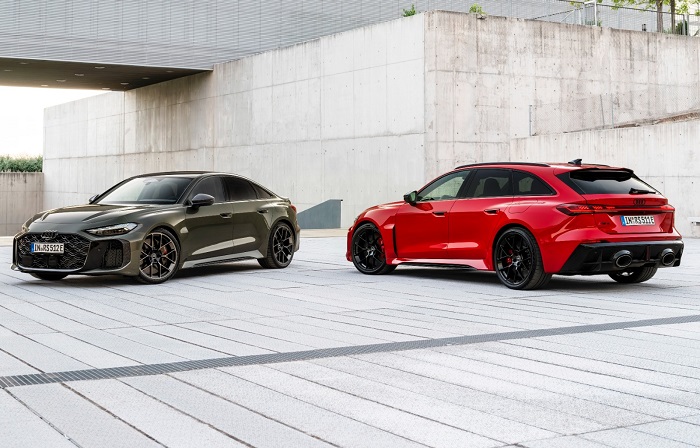
Key highlights (the “read this before your coffee cools” section)
- System output: 470 kW (639 PS), 825 Nm
- Electric-only range: up to 84 km, up to 87 km in the city (EAER)
- Charging: up to 11 kW AC, 0–100% in ~2.5 hours
- New quattro drivetrain: Dynamic Torque Control with electro-mechanical torque vectoring in rear transaxle (world first)
- Optional top speed: up to 285 km/h with Audi Sport package
- Design: wider bodywork, darkened Matrix LEDs, RS exhaust, bold RS interior details
Hybrid, but make it RS: How the drivetrain is engineered for both chaos and commute
Audi Sport’s new setup combines the reworked 2.9 V6 with a gearbox-integrated electric motor and a 25.9 kWh battery (22 kWh net). It’s designed to deliver strong response off the line, cleaner city driving, and sustained performance—helped by intelligent thermal management that actively optimises battery temperature for RS modes.
The charging story stays practical: 11 kW AC capability means a full charge in about 2.5 hours—the kind of number that sounds like it was invented for “finish lunch, then go hunting corners.”
And yes, there’s a Boost function: press a button and the RS 5 unleashes maximum acceleration for 10 seconds—perfect for overtakes, highway gaps, and explaining to your passenger why you suddenly developed “urgent confidence.”
The big tech flex: “Dynamic Torque Control” and why it matters
Audi’s headline innovation is the rear transaxle with electro-mechanical torque vectoring, part of “quattro with Dynamic Torque Control.” In simple terms: it can shuffle torque across the rear wheels incredibly quickly to improve traction, stability and rotation through corners. Audi says the system can react in around 15 milliseconds and computes targets at 200 Hz.
This is paired with a new centre differential featuring preload, keeping the drivetrain partially locked even off-throttle—aimed at sharper turn-in and reduced understeer during weight transfer.
Design & cabin: Wider, darker, more RS (and yes, it looks expensive standing still)
The RS 5 wears its motorsport inspiration loudly: wider stance, a honeycomb Singleframe grille, aggressive aero work, and RS oval exhaust tips. Audi also brings RS-specific lighting signatures, including a checkered-flag-themed DRL treatment in the Matrix LEDs.
Inside, Audi leans into the modern “screens are the new horsepower” era with a large central display plus driver-focused RS readouts, and optional RS-themed trims and stitching packages for buyers who want their cabin to look like it’s wearing racing gloves.
Pricing & timeline (Europe first)
Audi says European order books open in Q1 2026, with deliveries expected Summer 2026. In Germany, the RS 5 Sedan starts at €106,200 (INR 1.13 crore), and the RS 5 Avant at €107,850 (INR 1.15 crore).
Why Audi should launch the new RS 5 in India
India may not be the first market people associate with high-performance PHEVs, but the timing is quietly lining up—especially for a halo RS product that can do electric city duty and serious highway performance.
1) India’s luxury performance audience has matured (and wants the “new tech” story)
The performance-luxury customer in India is no longer buying only for badges—tech leadership matters. A 639 PS PHEV RS model is the kind of “engineering headline” that pulls attention, footfalls, and brand heat, even for buyers who eventually choose a Q5/Q7. (Halo cars are basically marketing… with launch control.)
2) PHEV fits Indian reality: EV driving where it’s easy, petrol power where it’s necessary
A full EV still depends heavily on predictable charging access. A PHEV lets owners do daily city running on electric power (especially in metro commutes) while keeping long-distance freedom for highways and intercity travel—without range anxiety becoming the third passenger. Audi’s claimed 80+ km electric range is particularly relevant for typical urban usage patterns.
3) Charging infrastructure is improving fastest in the exact cities that buy cars like this
Premium charging availability is rising primarily in large metros and affluent corridors—which is precisely where RS customers live, drive, and (let’s be honest) find reasons to “test the Boost button.” Even 11 kW AC home/workplace charging is a good match for luxury buyers with private parking.
4) It gives Audi India a strong “transition-era” performance flagship
As regulations, customer expectations, and product roadmaps move toward electrification, brands need a performance story that doesn’t feel like a compromise. A high-performance PHEV RS 5 positions Audi as:
“We’re going electric—without asking enthusiasts to behave.”
5) The policy/tax debate makes a case for a limited, brand-building launch—plus advocacy
Here’s the honest pinch point: EVs in India are taxed far lower than hybrids, and larger hybrids can face significantly higher GST slabs—often making hybrid performance cars expensive on-paper.
That’s exactly why a smart India strategy would be:
- limited allocation / CBU halo positioning first (brand & tech impact), and
- parallel work with ecosystem partners (charging, service readiness, customer education), while the industry continues pushing for clearer, pro-PHEV taxation in the premium segment.