If Italy ever decided to make a convertible love letter on four wheels, dipped it in espresso, sprinkled some Roman history on top and then sold it only to people who casually say “ex-showroom five point seven five crore” without blinking, the result would be the Ferrari Roma Spider.
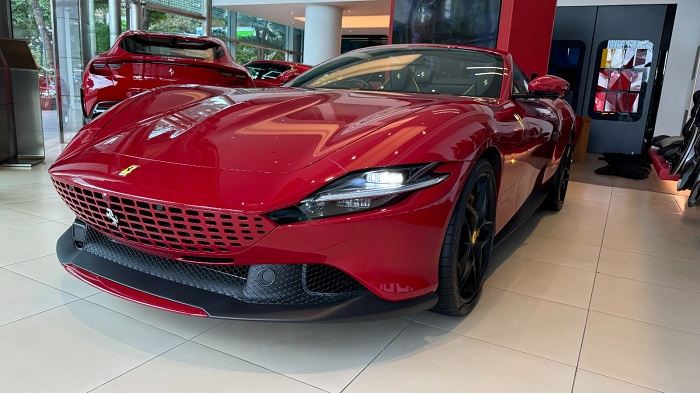
Yes, technically Ferrari Roma was first born in 2008, and what you’re looking at now is the 2025 fourth-generation model. But like most things from Italy, the timeline is a little flexible, the emotions are permanent, and the drama is absolutely intentional. In India, Roma comes only in petrol and only in Spider form, because Ferrari firmly believes that if you’re paying this much, you deserve wind in your hair, not a roof over your head. The coupe existed, briefly, like a serious relationship that didn’t work out, and was discontinued in 2024. It has now been replaced by the Amalfi, because even Ferrari likes to go on holidays.
The Roma Spider is assembled in Maranello, Italy, which is basically the Vatican for car enthusiasts. And historically, this car is special because after the legendary 1969 Ferrari 365 GTS4, this is only Ferrari’s second front-engined soft-top car ever. That’s like saying after fifty years, Ferrari finally trusted the idea of romance again.
The man behind this design is Flavio Manzoni, who is essentially the Michelangelo of modern Ferraris. He has designed everything from LaFerrari to Purosangue, from Monza SP1 to even the humble Volkswagen Up. So yes, the same brain that created hypercars also once designed a city hatchback. Which proves true talent is confusing. The Roma has won a Red Dot Design Award and several “Best Designed Car” trophies, and honestly, it deserves them. The name Roma itself is inspired by Rome, and the design takes cues from classic Ferraris like the 250 GT Lusso and 250 GT 2+2. The front gets a proper shark-nose effect, which basically means it looks like it could eat Lamborghinis for breakfast.
Dimension-wise, it is long, wide, low and heavy in a very expensive way: 4.6 metres long, 2 metres wide, just 1.3 metres tall, and 1570 kg kerb weight, with perfect 48:52 weight distribution. Ferrari engineers clearly sat with calculators, protractors and emotional attachment while balancing this thing.
You get five drive modes – Wet, Comfort, Sport, Race and ESC Off. Which roughly translate to: monsoon in Mumbai, daily traffic, weekend mood, YouTube reel, and life choices. There’s launch control, a three-position active rear spoiler, underbody vortex generators for aerodynamics, and the whole thing is based on the Portofino platform, which itself was already brilliant.
The headlights are slim full LED with horizontal DRLs and adaptive lighting, there’s a thermo-insulating windscreen, rain-sensing wipers, heated electrochromic mirrors with cameras, and even the grille is body-coloured with optional chrome or black. Ferrari even offers run-flat tyres, because they understand Indian roads better than some Indian brands.
Wheel lovers will be happy because you get 20-inch alloys with five design options, massive carbon ceramic brakes, and brake calipers in colours ranging from yellow to orange, blue, silver, white and red. Tyres are Pirelli P Zero as standard, with Michelin and Bridgestone options. Front tyres are 245-section, rear are fat 285s, because rear-wheel-drive Ferraris don’t believe in gym memberships.
Colour options? Twenty-five. The one you’re seeing is Rosso Mugello, but you can also choose orange, yellow, green, blue, silver, grey, black, white and combinations that probably require a Pantone chart and emotional stability.
This is a front-mid engine, rear-wheel-drive Grand Tourer, which means it’s supposed to be fast but also comfortable, like James Bond in loafers. There’s Magneride adaptive suspension with magnetorheological fluid, which sounds like something from a Marvel movie but basically adjusts stiffness instantly for both comfort and cornering.
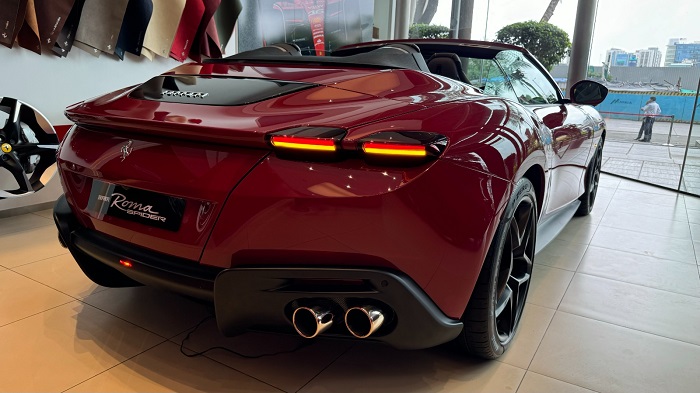
The roof is a five-layer fabric soft top, goes up or down in 13.5 seconds even at speeds up to 60 kmph, and uses a patented wind deflector. Ferrari engineers even worked on reducing the “ballooning effect”, which is basically when your roof behaves like a parachute at high speed. Very expensive problems.
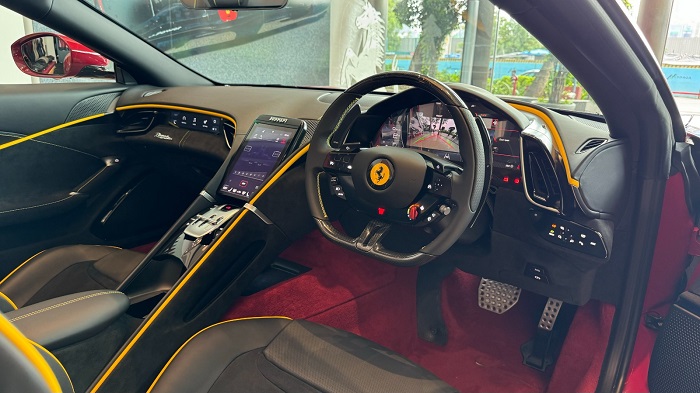
Inside, the Roma Spider goes full luxury theatre. You get a dual cockpit layout, 16-inch digital instrument cluster from the SF90, a carbon fibre multifunction steering wheel, Alcantara option, and an 8.4-inch portrait touchscreen with Android Auto, Apple CarPlay, navigation, WiFi, Bluetooth and everything except emotional support. Seats are 18-way electrically adjustable with ventilation and neck warmers, because Ferrari wants you comfortable while breaking speed limits.
Leather colour options are ridiculous: black, cream, brown, red, grey, orange, beige, blue and more. Stitching colours, carpets, seatbelts, headrest horse embroidery – everything is customisable. You can basically design a Ferrari that matches your living room curtains. There’s even a suitcase, duffel bag, suit holder and umbrella available, because apparently people who buy Ferraris still carry umbrellas.
Boot space with the roof up is 255 litres, which is enough for two people’s weekend bags or one person’s ego. There’s a hi-fi sound system, carbon fibre scuff plates, tonneau cover, dual-zone climate control, and an electrochromic frameless rear-view mirror.
Safety is surprisingly serious: four airbags, ABS, EBD, traction control, stability control, ADAS, blind spot monitoring, surround view camera, parking sensors, lane keep assist, traffic sign recognition, emergency call system, even ISOFIX mounts. So yes, your child seat will be safer than most hatchbacks.
Now comes the real star – the engine. This is Ferrari’s famous 3.9-litre V8 twin-turbo, code name F154 BH, producing 611 horsepower and 760 Nm torque. It does 0–100 kmph in 3.4 seconds, 0–200 in 9.7 seconds, and tops out at 320 kmph. Average? About 8 kmpl, which is honestly impressive for something that drinks fuel like espresso shots.
This engine is used in Portofino M, GTC4Lusso T, California T, and modified versions power the 488, F8, SF90 and even the modern Testarossa. Designed by Gianluca Pivetti, it features flat-plane crankshaft, dry sump lubrication, variable boost management, by-pass valve control for sound tuning, and a new oil pump that reduces cold start pressure time by 70%. Which means even Ferrari engineers worry about cold mornings.
The gearbox is the 8-speed dual-clutch from the SF90, lightning fast, paired with E-Diff3 electronic differential, Ferrari’s Side Slip Control 6.0, and Dynamic Enhancer software that adjusts brake pressure for better cornering. In simple terms, even if you’re not a racing driver, the car pretends you are.
Ferrari also offers seven years of complimentary maintenance, which sounds generous until you realise service happens every 20,000 km and parts cost more than small apartments.
So what is the Ferrari Roma Spider really? It’s not a hardcore track weapon like a 488, and it’s not a screaming hypercar like SF90. It’s Ferrari’s idea of a gentleman’s supercar – something you drive from Mumbai to Lonavala, from Monaco to Nice, from “board meeting” to “Instagram story”.
It’s elegant without being boring, fast without being scary, luxurious without losing its soul. It doesn’t shout like a Lamborghini. It smiles, adjusts its soft top, checks its neck warmer, and casually reminds you that it can hit 320 kmph whenever it feels like ruining your bank balance and your driving licence simultaneously.
The Roma Spider is not just a car. It’s Rome on wheels – ancient inspiration, modern technology, and just enough drama to make every drive feel like a movie scene where you are the hero, the villain, and the producer all at once.