
New Delhi: If India’s electric mobility journey were a movie, FY2025–26 would be the interval scene — dramatic, high-energy, and leaving you wondering, “What happens next?” According to the latest data released by the Federation of Automobile Dealers Associations (FADA), India’s EV retail story has not just grown — it has charged ahead at full voltage.
Clocking a total of ~24.52 lakh EV retail sales, the industry registered a robust 24.6% year-on-year growth, with every segment contributing meaningfully. From scooters quietly zipping through city lanes to electric three-wheelers dominating last-mile transport, India’s EV shift is no longer a future forecast — it’s happening in real time.
FADA President C S Vigneshwar aptly summed it up, calling FY26 a “watershed year” for India’s electric mobility story — and the numbers certainly agree.
⚡ Two-Wheelers Lead the Charge (Literally)
Electric two-wheelers continued to be the backbone of India’s EV adoption, crossing 14.01 lakh units in FY26, growing 21.81% YoY. Even more interestingly, EV penetration in the segment climbed to 6.5%, with March 2026 alone hitting a record 9.79% share — suggesting that urban commuters are increasingly swapping petrol pumps for charging plugs.
Among OEMs, TVS Motor Company emerged as the segment leader with over 3.41 lakh units, followed by Bajaj Auto and Ather Energy, both posting strong double-digit growth. Meanwhile, Ola Electric saw a sharp decline of over 52%, proving that in the EV race, consistency matters as much as innovation.
🔋 Three-Wheelers: India’s Silent EV Champions
If there’s one segment where electrification isn’t a trend but a takeover, it’s three-wheelers. With 8.30 lakh units sold and a commanding 60.9% market share, EVs have essentially become the default choice here.
Yes, you read that right — 6 out of every 10 three-wheelers sold in India are now electric. That’s not just growth; that’s a full-blown revolution on three wheels.
Mahindra Group led the segment with over 1.01 lakh units, while Bajaj Auto and TVS Motor posted strong gains. Interestingly, TVS recorded an eye-popping 1540% growth, indicating aggressive expansion in this space.
🚗 Passenger Vehicles: The Fastest Growing Segment
Electric passenger vehicles were the star performers of FY26, growing a massive 83.63% YoY to reach 1,99,923 units — just shy of the 2 lakh milestone.
EV market share in PVs rose from 2.6% in FY25 to 4.2% in FY26, showing that Indian car buyers are gradually warming up to electric options — and perhaps to the idea of silent acceleration and zero tailpipe emissions.
Tata Motors continued its dominance with 78,811 units, followed by JSW MG Motor India at 53,089 units. But the biggest surprise came from Mahindra & Mahindra, which posted a staggering 407% growth, signaling that the EV SUV battle is heating up fast.
Luxury brands like BMW and BYD also saw strong traction, while newer entrants like VinFast and Tesla India began making their presence felt — even if just warming up their batteries for now.
🚛 Commercial Vehicles: Small Base, Big Surge
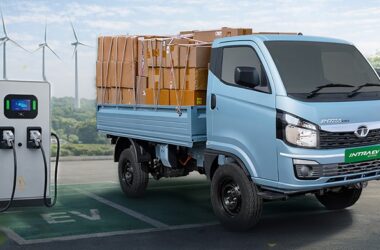
Electric commercial vehicles might still be a small piece of the pie, but they’re growing at startup-level speed. FY26 saw 19,454 units sold, marking a whopping 120.57% YoY growth.
Segment share nearly doubled to 1.83%, indicating increasing adoption in logistics, fleet operations, and public transport.
Tata Motors led the pack with 6,023 units, while Mahindra Group and Switch Mobility also showed strong performance. Interestingly, players like Tivolt Electric Vehicles posted astronomical growth rates — albeit on a smaller base — proving that the segment is ripe for disruption.
📊 The Bigger Picture: A Structural Shift, Not a Spike
What makes FY26 special isn’t just the numbers — it’s the breadth of growth. Every segment, from two-wheelers to commercial vehicles, posted strong double-digit gains. This isn’t a subsidy-driven spike or a temporary trend — it’s a structural shift.
From the buzzing streets of Tier-1 cities to the narrow lanes of small towns, EVs are steadily becoming mainstream. Charging infrastructure is expanding, OEM portfolios are diversifying, and consumers are becoming more confident.
Or as one might say — India’s EV journey has moved from “Should I buy one?” to “Which one should I buy?”
FY26 has firmly established India as one of the fastest-growing EV markets globally. Whether it’s the practicality of electric autos, the convenience of e-scooters, or the rising appeal of electric SUVs, the transition is happening across price points and use cases.
And if this is just the interval… the second half promises even more electrifying action.