



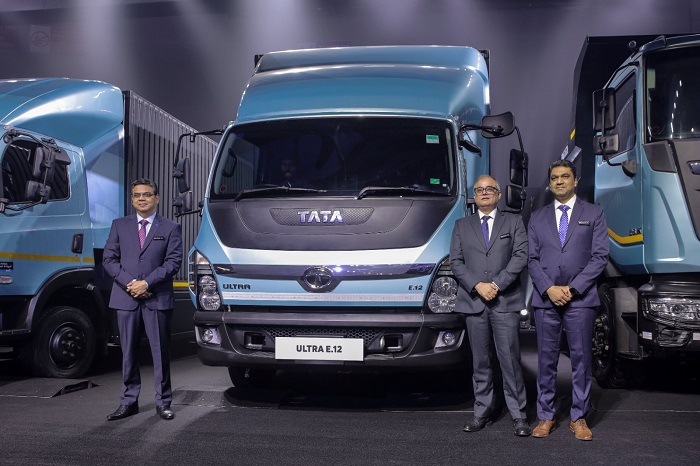
Mumbai: If India’s highways had a heartbeat in February, it probably sounded like a Tata diesel engine clearing its throat confidently. Tata Motors Limited reported a robust 32% year-on-year growth, clocking 42,940 commercial vehicle (CV) units in domestic and international markets, compared to 32,533 units in February 2025.
In an industry where even single-digit growth can spark celebration, a 32% jump is less “steady progress” and more “clear the fast lane.”
MH&ICV Segment Leads the Charge
The Medium & Heavy Commercial Vehicle (MH&ICV) segment delivered a particularly strong performance. Domestic and international sales combined stood at 22,512 units in February 2026, up from 16,693 units in the same month last year — marking an impressive 34.9% YoY growth.
From long-haul freight corridors to infrastructure projects and public mobility networks, Tata’s heavy-duty portfolio seems to be doing exactly what it’s designed for — carrying India’s ambitions, one axle at a time.
Eight Decades of Commercial Leadership
Part of the USD 180 billion Tata Group, Tata Motors Limited is India’s largest and globally renowned manufacturer of utility vehicles, pick-ups, trucks and buses. With over eight decades of leadership in commercial mobility, the company has built a reputation around innovation, reliability and performance.
Its advanced powertrains, connected vehicle technologies and intelligent fleet solutions today serve a wide range of applications — from last-mile delivery vans zigzagging through urban lanes to high-capacity trucks powering inter-state logistics. In short, if goods move in India, chances are a Tata vehicle is involved somewhere in the story.
Guided by its brand promise “Better Always,” Tata Motors continues to deliver future-ready solutions that enhance customer experience while driving sustainable growth. The company operates in India and South Korea, with a global presence spanning Africa, the Middle East, Latin America, Southeast Asia and SAARC countries.
A Structurally Stronger Tata Motors
The strong February numbers also come in the backdrop of a significant corporate restructuring. As per the Composite Scheme of Arrangement sanctioned by the Hon’ble National Company Law Tribunal, Mumbai Bench, the company’s name was formally changed to Tata Motors Limited effective 29 October 2025. Its equity shares have been listed on the Bombay Stock Exchange and the National Stock Exchange of India Limited since 12 November 2025.
The restructuring has streamlined operations and sharpened strategic focus, enabling the company to accelerate growth across segments — especially commercial vehicles, where demand has been buoyed by infrastructure push, logistics expansion and replacement cycles.
Growth with Purpose
Beyond volume growth, Tata Motors continues to strengthen its commercial vehicle portfolio with cleaner technologies, connected fleet platforms and sustainable mobility solutions. From conventional diesel powertrains to electric and alternative fuel solutions, the company is steadily aligning with India’s evolving mobility landscape.
February’s performance suggests that freight demand, infrastructure spending and fleet modernisation are all working in tandem. And if the current momentum continues, Tata Motors’ CV business might just make 2026 a year to remember — for balance sheets and highways alike.
Because sometimes, growth isn’t just a number. Sometimes, it’s 42,940 vehicles rolling confidently into the future.
| Category | February 2026 | February 2025 | Growth (Y-o-Y) |
| HCV Trucks | 13,559 | 9,892 | 37.1% |
| ILMCV Trucks | 7,577 | 5,652 | 34.1% |
| Passenger Carriers | 5,548 | 4,355 | 27.4% |
| SCV cargo and pickup | 14,209 | 10,898 | 30.4% |
| Domestic Sales | 40,893 | 30,797 | 32.8% |
| International Business | 2,047 | 1,736 | 17.9% |
| Total | 42,940 | 32,533 | 32.0% |