

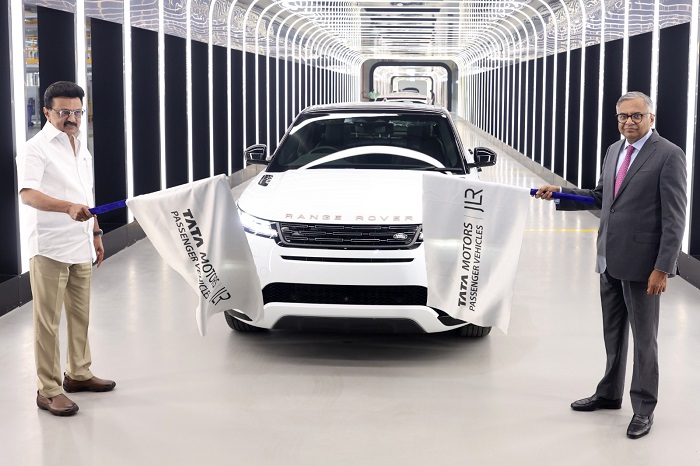
Panapakkam, Ranipet — India’s auto manufacturing map just got a bold new dot. Tata Motors Passenger Vehicles has officially begun operations at its brand-new greenfield manufacturing facility in Panapakkam, Ranipet district — and in a delightfully global twist, the first car to roll out is not a Tata, but a locally built Range Rover Evoque from its British luxury subsidiary, Jaguar Land Rover.
Yes — Tamil Nadu just said “Vanakkam” to the Evoque.
The plant marks the first phase of a large, future-focused manufacturing hub that will produce next-generation vehicles, including electric models, for both Tata Motors Passenger Vehicles (TMPV) and JLR brands.
Inaugurated With Full State & Industry Muscle
The facility was formally inaugurated by Tamil Nadu Chief Minister M. K. Stalin alongside Tata Sons and TMPV Chairman N. Chandrasekaran, in the presence of ministers, senior bureaucrats, Tata Group leaders, and industry officials — essentially a guest list that could approve a highway, a policy, and a production line in one meeting.
CM Stalin highlighted the project as a major boost to Tamil Nadu’s manufacturing leadership, noting that the Tata Group’s expansion strengthens the state’s role as a national mobility and industrial hub while generating jobs and innovation.
Chandrasekaran called the plant a milestone in the Tata Group’s push toward “sustainable and future-ready manufacturing,” adding that vehicles built here will target both Indian and global markets.
First Car Out: Luxury Goes Local
The headline grabber is the local manufacturing of the Range Rover Evoque, a globally recognized luxury SUV known for its design, craftsmanship, and urban-friendly premium appeal.
Local production is expected to improve supply flexibility and potentially sharpen pricing and availability strategies over time. It also signals deeper manufacturing integration between Tata Motors and JLR — a relationship that has steadily moved from boardroom synergy to shopfloor reality.
In simple terms: fewer ships, more shifts.
A Plant Built for Scale — and Skills
The Panapakkam facility is designed with advanced manufacturing technologies and will scale production in phases to a full annual capacity of 250,000 vehicles over the next 5–7 years.
But the more interesting engine here might be human, not mechanical.
A large part of the shopfloor workforce comes from across Tamil Nadu and is enrolled in Tata Motors’ Lakshya programme — an “earn while you learn” initiative that transforms polytechnic graduates into industry-ready specialists. Selected candidates underwent five months of intensive hands-on training at JLR facilities and can pursue a company-sponsored B.Tech degree while working.
It’s not just Make in India — it’s Train in India, Upgrade in India, Lead in India.
₹9,000 Crore Bet on the Future
TMPV plans to invest approximately ₹9,000 crore in the facility over time. The project is expected to generate over 5,000 direct and indirect jobs while supporting a broader supplier and ancillary ecosystem in the region.
The plant is also engineered around a sustainability-first philosophy:
- Operates on 100% renewable energy
- Designed to be water positive
- Built with high-efficiency, low-emission processes
- Benchmarked against global green manufacturing standards
In other words, the factory aims to leave lighter footprints while producing heavier metal.
The Bigger Picture
With Tata’s domestic strength and JLR’s global luxury portfolio now sharing production ground in Tamil Nadu, the Panapakkam plant represents more than just another factory — it’s a strategic convergence of premium, electric, and export-ready manufacturing.
And if the opening act is an Evoque, the sequel lineup is likely to be worth watching — preferably with a hard hat on.