
Maranello / San Francisco — In a move that will delight driving purists and confuse touchscreen addicts, Ferrari Luce has officially revealed its interior and human–machine interface — and with it, the name that launches a completely new electric chapter for the Prancing Horse. Yes, it’s electric. No, it’s not a giant iPad on wheels.
Ferrari’s upcoming full-electric sports car, Luce — Italian for “light” — is being positioned not just as a new model, but as a new segment starter for the brand. And instead of shouting about kilowatts and charging curves, Ferrari is talking about philosophy, tactility, craftsmanship — and gloriously clicky buttons.
Somewhere, a touchscreen just felt nervous.
Not Just a Cabin — A Design Manifesto with a Seatbelt
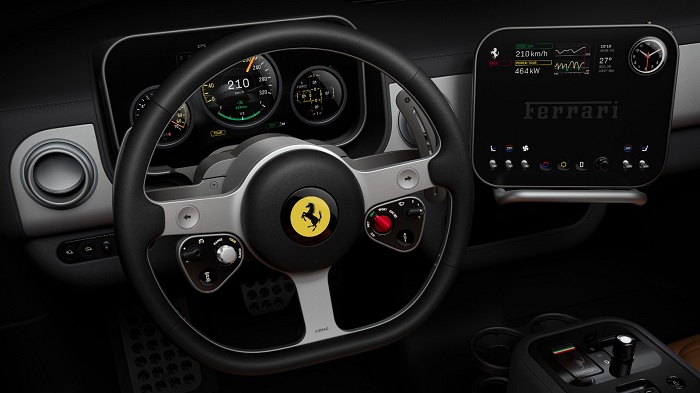
Ferrari describes Luce as “electrification as a means, not an end,” and that thinking is most visible inside the cabin. The interior has been conceived as a clean, single volume focused on driving clarity — not digital clutter.
The user interface blends:
- Precision mechanical buttons, toggles and dials
- Multifunction digital displays
- CNC-machined aluminium controls
- Gorilla Glass surfaces
- Minimalist, aviation-inspired graphics
In short: fewer swipes, more satisfaction.
The project has been developed in collaboration with LoveFrom, the San Francisco creative collective founded by Jony Ive and Marc Newson, working closely with the Ferrari Styling Centre led by Flavio Manzoni. The goal: build an interface that feels engineered, not merely installed.
Ferrari vs The Touchscreen Era: The Counterattack
While most EV interiors resemble a tablet that swallowed a dashboard, Ferrari Luce goes the other way. Physical controls are back — and not as decoration.
Key interface highlights include:
- Mechanical steering wheel buttons with tuned acoustic feedback
- Toggle switches inspired by Formula One layouts
- Dedicated analogue-style control modules
- Palm-rest supported central control panel
- Reduced cognitive load through glance-readable graphics
Ferrari says over 20 evaluation tests with test drivers were conducted just to perfect button feel and sound. Yes — the click matters.
This may be the first EV where your fingers get as much joy as your right foot.
Steering Wheel: Retro Soul, Space-Age Diet
The Luce steering wheel reinterprets classic 1950s–60s three-spoke Ferrari wheels with exposed aluminium structure. Built from 100% recycled aluminium alloy, it uses 19 CNC-machined parts and weighs 400 grams less than a standard Ferrari wheel.
That’s right — Ferrari went on a steering wheel diet before most of us did.
Controls are arranged like a Formula One car: clean zones, analogue modules, and intuitive reach — because hunting through menus at 250 km/h is generally discouraged.
The Key That Performs a Magic Trick
Ferrari has turned the simple act of starting the car into theatre.
The Luce key is made from Corning Gorilla Glass and features an automotive-first E-Ink display. When docked into the central console:
- The key colour shifts from yellow to black
- Console and binnacle illuminate together
- A start-up sequence signals “showtime”
It’s part ignition ritual, part stage lighting cue.
Displays That Respect Your Eyes (And Your Sanity)
The Luce uses a three-display architecture:
- Driver binnacle
- Central control panel
- Rear control panel
The standout feature is the steering-column-mounted binnacle — a first for a road-going Ferrari — that moves with the wheel’s rake and reach. It uses overlapping OLED displays with precision cut-outs, developed with Samsung Display engineers, to create layered visual depth.
Graphics are inspired by:
- 1950s–60s Veglia and Jaeger instrument dials
- Aviation and helicopter display logic
- Watch-dial legibility principles
Ferrari’s design rule here is simple: if you can read a chronograph at a glance, you should be able to read your speed just as easily.
The Multigraph: Because Why Should Watches Have All the Fun?
At the centre sits a micro-engineered multigraph — a mechanical-digital hybrid with three independent motors and anodised aluminium hands. It can switch between:
- Clock
- Chronograph
- Compass
- Launch control
Yes, your launch control now has watchmaking drama. Swiss horology just nodded in approval.
Materials: Recycled, Machined, Overachieving
Ferrari Luce’s interior materials are chosen for authenticity and durability, not just visual drama:
- 100% recycled aluminium alloy
- Solid-billet CNC machining (3- and 5-axis)
- Advanced anodisation for micro-texture and colour depth
- Gorilla Glass for shifter, console, and control surfaces
- Laser micro-perforation for ultra-precise graphics in glass
Ferrari says materials must feel “noble.” Which is a polite Italian way of saying: if it doesn’t feel expensive, it’s not invited.
Launch Timeline: Three Acts, One Electric Opera
Ferrari is staging the Luce reveal in phases:
- Technology platform — unveiled October 2025 at Ferrari’s e-building in Maranello
- Interior & interface — now revealed in San Francisco
- Exterior reveal — scheduled for Italy, May 2026
Think of it as a trilogy — with fewer dragons and more electrons.
The Big Picture: Ferrari Goes Electric — But Keeps the Drama
With Luce, Ferrari isn’t just entering the EV era — it’s trying to redesign how drivers emotionally connect with electric performance. The emphasis on tactile controls, mechanical feedback, and visual clarity suggests a deliberate move away from “screen-first” design.
In other words: the future may be electric, but Ferrari still wants it to feel analog in all the right places.
And if Luce truly means “light,” Ferrari clearly intends to keep the driver at the center of it — brightly illuminated, properly seated, and very much in control.