The Tata Harrier has always been one of those cars that walks into a parking lot with the confidence of a Bollywood entry scene—slow motion, dramatic background score, and everyone automatically assuming it’s either a politician’s car or someone who just got a big promotion. Launched back in 2018, the Harrier practically announced Tata’s comeback into the serious SUV space, and what you are looking at now is the 2026 first-generation facelift, which is basically the same strong personality but after going to the gym, a skincare routine, and learning a bit of artificial intelligence on the side.
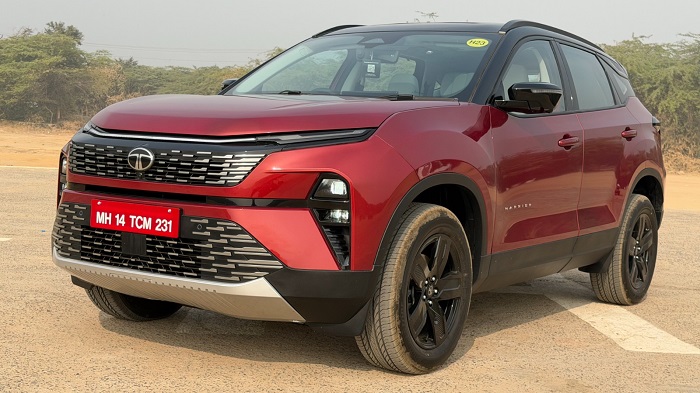
This is an Indian crossover SUV in the truest sense—big, bold, comfortable for families, intimidating for traffic, and now available in petrol, diesel, and even electric. The pricing starts from around ₹12.89 lakh ex-showroom and goes all the way up to about ₹25.24 lakh for the top variant, which means the Harrier politely covers everything from “upper-middle-class dream” to “corporate parking lot statement.” The one you’re looking at here is the Fearless Ultra Petrol variant, which sounds less like a car and more like a Marvel superhero, but honestly, it kind of behaves like one too.
And yes, if you are thinking green, there is also an electric Harrier, starting at around ₹21.49 lakh, which basically says, “I care about the environment, but I also want 360-degree cameras and Dolby Atmos.” If you need more seats because your family is growing faster than your EMI, the seven-seater version is called the Safari, starting at ₹13.29 lakh, and it’s basically the Harrier after doing a PhD in hospitality management.
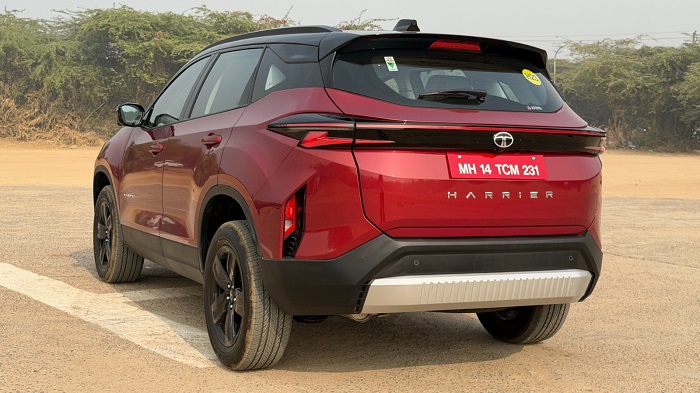
Design-wise, this SUV has serious pedigree. It’s designed by Martin Uhlarik, the same man behind the Nexon, Punch, and Safari. So yes, the guy basically designed half of India’s parking lots. In some international markets, it’s also known as Buzzard Sport or H5, which sounds like a gaming console, but here in India, Harrier remains the name that actually suits its personality—strong, sharp, and slightly intimidating in the rear-view mirror.
Under the skin, the Harrier is built on Tata’s Omega Arc platform, which is derived from Land Rover’s D8 architecture. That’s the same family tree as the Discovery Sport and Range Rover Evoque, which means, technically speaking, you are driving a distant cousin of a Range Rover at a fraction of the price. This is probably the only Indian car where you can casually say, “Yeah, it’s basically Land Rover DNA,” and not get laughed out of the room. It’s also one of the few cars in the segment to score five stars in both Global NCAP and Bharat NCAP, so you’re not just looking premium—you’re also statistically safer than most people on Indian roads.
The Harrier is assembled in Pune, and physically, it’s a proper big boy. About 4.6 metres long, nearly 1.9 metres wide, 1.7 metres tall, with around 205 mm of ground clearance and a kerb weight close to 1700 kg. In simple terms, potholes are scared of this car. It rides on 18-inch alloys in this variant, though you can also get 17 or 19 inches, with disc brakes on all four wheels and chunky 235/60 R18 Bridgestone tyres. The colour you’re seeing here is Nitro Crimson Red, which looks like the car drank Red Bull and decided to become a superhero. You also get yellow, grey, white, green, and in dual-tone, only black roof—because black roofs are the automotive version of wearing sunglasses indoors.
From the outside, the Harrier looks like it’s constantly ready for a photoshoot. The parametric grille, connected LED DRLs with sequential indicators and welcome-goodbye animations, bi-LED projector headlamps with high beam assist, LED fog lamps with cornering function, rain-sensing wipers, front and rear parking sensors, air curtains, and even a camera with washer. Yes, even the camera gets a bath in this car. Luxury is when even your car’s camera lives better than you.
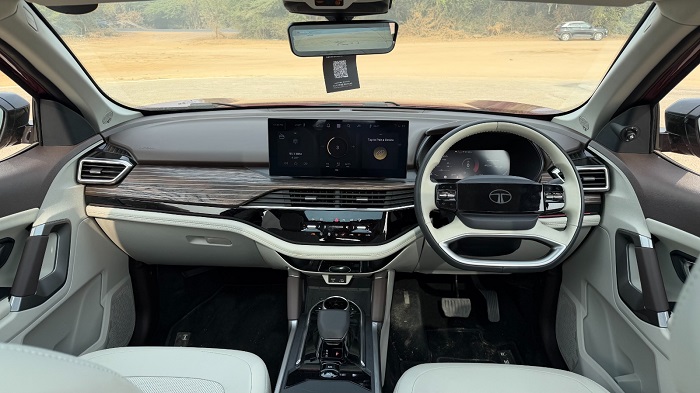
Step inside and the Harrier shifts from “SUV” to “premium lounge on wheels.” You get white leatherette upholstery, though brown, black, red, and fabric are also available. There are winged comfort headrests, multicolour ambient lighting, sun blinds, ventilated front seats, 60/40 split rear seats, sliding armrest, cooled storage, and even a boot you can open by waving your foot like you’re casting a spell. Boot space is 445 litres, which becomes 815 litres when you fold the seats—basically enough for a full family trip or half of IKEA.
The highlight, though, is the massive 14.5-inch Samsung Neo QLED touchscreen by Harman, which feels less like a car screen and more like a home theatre. It supports Amazon Prime Video, JioHotstar, Mappls navigation, Alexa Home2Car, wireless Android Auto and Apple CarPlay, over 250 voice commands, 13 JBL sound modes, Wi-Fi, USB, FM radio, and more apps than some smartphones. Lower variants get slightly smaller screens, but even those are bigger than what most cars used to offer just a few years ago. Add to that a 10.24-inch digital instrument cluster, electrochromic IRVM with built-in dashcam and DVR, dual-zone climate control with air purifier and AQI display, panoramic sunroof with voice command, and suddenly your car feels more intelligent than your office laptop.
Sound is handled by a 10-speaker JBL system with subwoofer and Dolby Atmos. Yes, Dolby Atmos in a Tata. At this point, your Spotify playlist will sound better in your car than in your living room.
On the tech and safety side, the Harrier is basically a rolling PhD thesis. You get Level 2 ADAS with 22 functions, including autonomous emergency braking, adaptive cruise control, lane keep assist, lane centering, blind spot detection, rear cross traffic alert, traffic sign recognition, door open alert, and so on. There are seven airbags, electronic stability program with 17 functions, hill hold, hill descent, traction control, rollover mitigation, corner stability, panic brake alert, brake disc wiping, ISOFIX, tyre pressure monitoring, and a perimetric alarm system. In short, the Harrier is constantly watching you, the road, the traffic, and probably your life choices.
Then comes iRA 2.0 connected car tech, free for one year, which allows you to remotely start the engine, switch on AC, lock or unlock doors, track the car, set geofencing, get intrusion alerts, check live diagnostics, do OTA updates, and even immobilise the car remotely. Basically, even if you forget your car, your car will not forget you.
Driving the Harrier is where things get interesting. You get three drive modes—Eco, City, and Sport—and three terrain modes—Normal, Rough, and Wet. Suspension is tuned for Indian roads, with independent front and semi-independent rear, which means it absorbs bad roads with the emotional strength of an Indian parent: silently and without complaint.
The petrol engine is a 1.5-litre turbocharged GDi unit producing 167 horsepower and 280 Nm of torque, paired with either a 6-speed manual or a 6-speed Aisin torque converter automatic. It’s built with AI and machine learning-based optimisation, smart shift assist, launch assist, intelligent lubrication, variable geometry turbo, and enough technical jargon to scare mechanical engineers. It returns around 13 kmpl, which is respectable for a car that looks like it could tow a small house.
The diesel, on the other hand, is the famous 2.0-litre Kryotec based on Fiat Multijet II, also making 167 horsepower but a stronger 350 Nm torque. Mileage is around 14 kmpl for automatic and 16 kmpl for manual. Both engines are BS6 Phase 2 compliant, and the petrol even gets an 80 kg weight reduction, which is basically the automotive equivalent of skipping dessert.
There’s also a three-year or one-lakh-kilometre warranty, which means Tata is confident you’ll either love the car or at least not break it anytime soon.
So what is the Tata Harrier really? It’s that rare Indian SUV that manages to blend design, safety, technology, performance, and practicality without trying too hard to be German or pretending to be something it’s not. It’s unapologetically Indian, but with global engineering, Land Rover genes, and a feature list that reads like a luxury brochure.
In simple words, the Harrier is for someone who wants a premium SUV, wants to feel safe, wants all the latest tech, wants space for family, wants style for Instagram, and still wants to say proudly, “Haan bhai, Tata hai.” And honestly, in 2026, that’s not just a patriotic statement—it’s a genuinely smart one too.