



The Kia Seltos is not just a car in India; it is a phenomenon. When it first arrived in 2019, it didn’t politely enter the segment—it kicked the door open, rearranged the furniture, and told everyone else to keep up. Fast forward to 2026, and what you are looking at now is the second-generation Kia Seltos, a crossover SUV that has clearly grown up, gone to design school, learned technology fluently, and still remembered to keep its gym membership active.
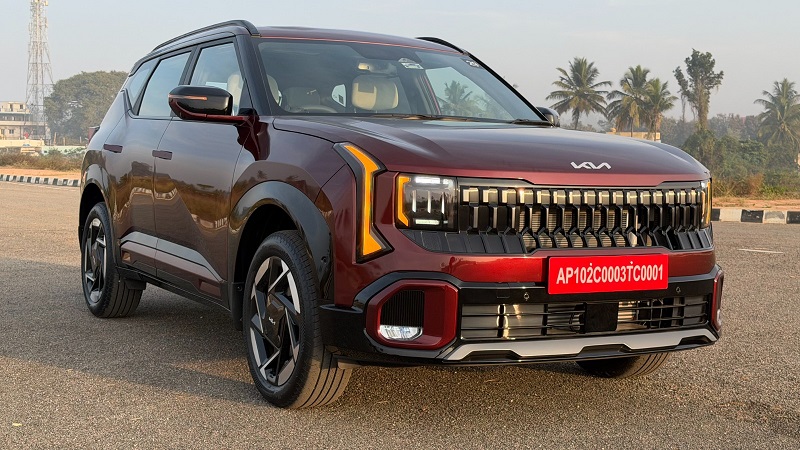
This is the GTX variant, and the internal codename for this generation is SP3i, which sounds technical enough to convince engineers and mysterious enough to impress dinner guests. Offered in both petrol and diesel, the Seltos lineup starts at around ₹11 lakh ex-showroom and stretches all the way to ₹20 lakh for the fully loaded variants. That price band neatly explains why you see the Seltos everywhere—from gated communities to hill highways and office parking lots where status is measured in inches of touchscreen.
Kia backs the Seltos with a three-year unlimited kilometre warranty, which can be extended up to seven years, along with three years of 24×7 roadside assistance. That kind of confidence is reassuring, especially when your car is expected to deal with Indian traffic, unpredictable roads, and the occasional enthusiastic speed breaker.
Design is where this Seltos makes its biggest statement. Styled under Kia’s “Opposites United” philosophy, the SUV blends sharp aggression with smooth sophistication. The man responsible for this design is Karim Habib, whose résumé includes everything from the BMW X6 and 7 Series to the Kia Carnival, Carens, Sorento and Optima. In other words, the Seltos has been designed by someone who knows exactly how to make a car look expensive without making it intimidating.
Up front, the Digital Tiger Face grille finished in black high gloss sets the tone, flanked by Ice Cube LED projector headlamps that don’t just illuminate the road but also perform a dramatic welcome sequence every time you approach the car. There is a barbell-inspired bumper design, LED fog lamps, skid plates at both ends, and Star Map LED DRLs with integrated turn indicators that look futuristic without being overdone. Even details like the aero-type wiper blades and roof-side garnish have been thought through, which tells you this isn’t a last-minute refresh but a ground-up evolution.
The electrically adjustable outside mirrors fold automatically, remember positions, tilt while reversing, carry cameras, and flash indicators—all while wearing gloss black cladding that reinforces the SUV stance. Dimensionally, the Seltos sits comfortably in the Indian sweet spot with a length of around 4.4 metres, width close to 1.8 metres, height just under 1.6 metres, and a ground clearance of 200 mm. It looks planted, proportionate, and confident without trying too hard.
This GTX variant rides on sporty 18-inch crystal-cut alloy wheels wrapped in 215/55 R18 Apollo Apterra Cross tyres, with disc brakes at both ends. The Magma Red colour seen here looks particularly striking, though Kia also offers a wide palette including blue, silver, olive, grey, black, white and matte grey, along with dual-tone options featuring a black roof. No matter which shade you choose, the Seltos carries itself like it knows it belongs in the premium conversation.
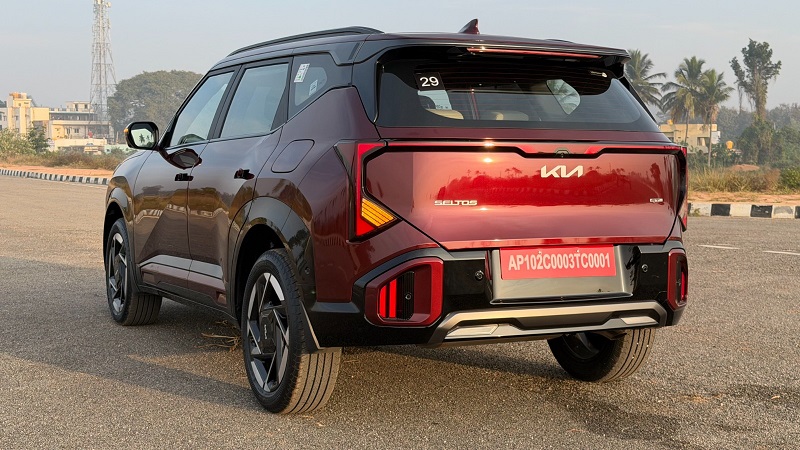
At the rear, the design continues to impress with connected Star Map LED tail lamps, a barbell-inspired bumper, LED reverse lights, an integrated spoiler with a high-mounted stop lamp, and a cleverly hidden rear wiper. Even the underbody aerodynamics have been improved, which contributes to a drag coefficient of just 0.31—excellent for an SUV of this size.
Under the skin, the Seltos is built on Hyundai-Kia’s K3 platform, shared with several global models including the Creta, Verna, Elantra and Niro. Engineers have lowered the centre of gravity to improve handling, while a multi-load path structure enhances crash safety. The body uses ultra-high-strength steel along with hot-stamped components, including ten hot-stamping structural parts, giving the Seltos a solid, confidence-inspiring feel. Assembly takes place at Kia’s Anantapur facility in Andhra Pradesh, one of the most advanced manufacturing plants in the country.
Safety and driver assistance are major highlights of the new Seltos. It comes equipped with Level 2 ADAS, supported by three radars, one dedicated ADAS camera, and four surround-view cameras. On the road, this translates into features like forward collision avoidance, lane keeping and lane following assist, blind view monitoring, rear cross-traffic avoidance, safe exit warning, driver attention monitoring, parking collision avoidance and leading vehicle departure alerts. It feels like having a co-driver who never gets tired and never looks at their phone.
Standard safety equipment includes six airbags, ABS, electronic stability control, vehicle stability management, hill-start assist, downhill brake control, rollover sensor, ISOFIX mounts, rear occupant alert, tyre pressure monitoring, auto hold, impact-sensing door unlock and three-point seatbelts for all occupants. Simply put, the Seltos doesn’t cut corners when it comes to protecting its passengers.
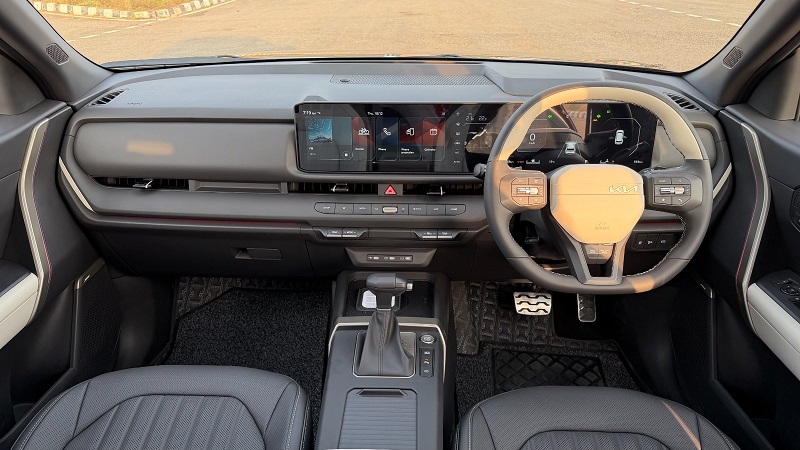
Inside the cabin, the Seltos makes an immediate impression with its massive 30-inch Trinity Panoramic Display Panel that stretches across the dashboard. The dual 12.3-inch HD screens handle infotainment and instrumentation, creating a cockpit that feels modern, clean and very premium. The touchscreen supports wireless Android Auto and Apple CarPlay, over-the-air updates, split-screen functionality and multi-language support. Below it sits a dedicated 5-inch touchscreen just for climate control, which feels intuitive and surprisingly satisfying to use.
The interior ambience is lifted by leatherette upholstery in multiple colour combinations, leatherette dashboard and door trims, a sporty black roof lining, 64-colour ambient lighting, and thoughtfully designed details like mesh-type headrests and alloy pedals. The front seats are ventilated, and the driver gets a 10-way power-adjustable seat with lumbar support and a welcome retract function that makes entry and exit feel special every single time.
Rear seat passengers are treated just as well, with generous legroom, sunshade curtains, LED reading lights, and a 60:40 split folding seatback. Boot space stands at 447 litres, more than enough for airport runs, weekend trips or the inevitable shopping spree that happens “accidentally.”
Sound duties are handled by an eight-speaker, 400-watt Bose premium audio system, while Kia Connect 2.0 brings a long list of connected features accessible through your smartphone. You can remotely control the AC, ventilated seats, windows, horn and lights, track the vehicle with surround-view visuals, set geo-fences and speed alerts, monitor vehicle health, access service and warranty history, and even receive over-the-air updates. At times, the Seltos feels less like a car and more like a smart device with wheels.
Powertrain options remain familiar but effective. The 1.5-litre turbo petrol produces 157 horsepower and 253 Nm of torque, paired beautifully with a 7-speed dual-clutch automatic that feels quick, smooth and eager. There is also a naturally aspirated 1.5-litre petrol for those who prefer simplicity, and a 1.5-litre diesel delivering strong torque and impressive efficiency. Gearbox choices include manual, iMT, IVT and automatic options depending on the engine. While global markets get AWD, hybrid options and larger engines, the Indian lineup remains focused on balance, efficiency and reliability.
Ride and handling strike a pleasing compromise. The suspension setup, with McPherson struts at the front and a coupled torsion beam at the rear, absorbs bad roads well while keeping the car stable and predictable at highway speeds. Steering is motor-driven, precise, and even supports software updates, which is something you expect from smartphones, not SUVs.
So, what is the Kia Seltos really about? It is about offering safety, space, comfort and technology in a package that feels aspirational yet practical. It is designed for modern Indian families who want sophistication without sacrificing usability, and excitement without unnecessary complexity.
The 2026 Kia Seltos doesn’t try to reinvent the segment—it simply perfects the formula it created. And that, perhaps, is its biggest achievement.