Mumbai:
If consistency had a four-wheeled mascot in India right now, it might just wear a Tata badge. Tata Motors Passenger Vehicles Ltd. closed Q3 FY26 on a high note, registering combined domestic and international sales of 171,013 units, a healthy jump from 139,829 units in Q3 FY25—proof that momentum, when handled carefully, doesn’t skid.
Speaking on the performance, Shailesh Chandra, MD & CEO, highlighted how calendar year 2025 turned into a landmark one for Tata Motors. The company notched up its fifth consecutive year of record PV sales, delivering 587,218 units, including its highest-ever EV volumes of 81,125 units—clearly signalling that electrification is no longer a side quest, but part of the main storyline.
GST 2.0 Boost, SUVs Lead the Parade
The momentum triggered by GST 2.0 towards the end of Q2 FY26 gathered serious pace in Q3. Tata Motors Passenger Vehicles recorded its highest-ever quarterly wholesales of 171,103 units, while retail registrations crossed the 200,000-unit mark for the first time—a milestone that quietly says, “This is getting serious now.”
At the front of the convoy was the Tata Nexon, which emerged as India’s top-selling car/SUV in October and November and is cruising towards a Q3 tally of nearly 64,000 units. Not to be outdone, the Tata Punch continued to dominate its segment, while the Tata Tiago delivered robust growth—proving that hatchbacks still have plenty of punch left in them.
December Delivers, Inventory Slims Down
December turned out to be another highlight, with 22% year-on-year growth. Interestingly, retail sales outpaced wholesales, pulling dealer inventory down to a lean ~18 days—a clear sign of demand-led growth and disciplined channel management. In simpler terms: cars moved faster than stockyards could count them.
Powertrain Buffet Pays Off
Tata Motors’ multi-powertrain strategy delivered strong results across the board. CNG volumes crossed 47,000 units, SUV sales rose 18% YoY, and EV adoption accelerated sharply with a 50% YoY growth. Longer ranges, lifetime battery warranties, improved capabilities, and price parity with ICE models ensured that EV curiosity translated into real-world registrations.
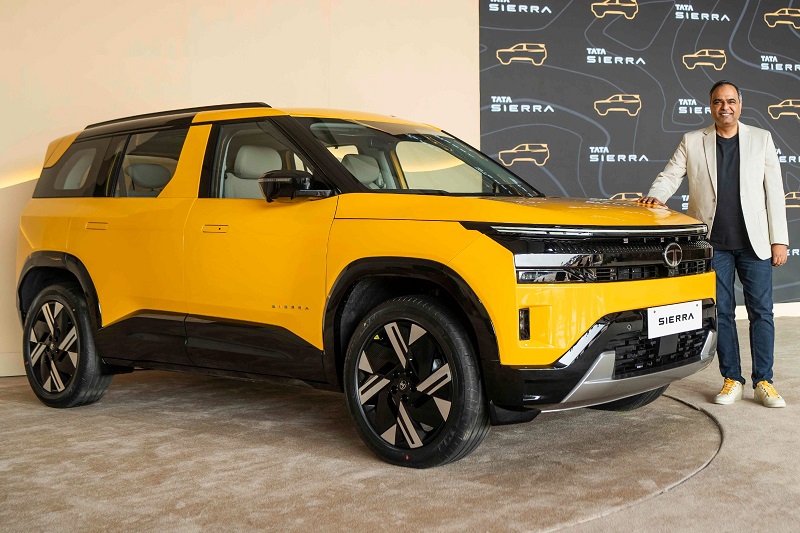
Q3 FY26 also saw important product moves, including petrol avatars of the Tata Harrier and Tata Safari, along with the much-anticipated launch of the Tata Sierra—a nameplate that arrived carrying both nostalgia and next-gen intent, and was met with an enthusiastic response.
Road Ahead Looks Busy—and Promising
Looking forward, Tata Motors Passenger Vehicles remains confident about industry growth. With deliveries of newly introduced products starting in Q4 FY26 and a packed pipeline of launches and innovations lined up, the company appears well-positioned to accelerate further.
In short, Q3 FY26 wasn’t just about numbers—it was about rhythm. And right now, Tata Motors Passenger Vehicles seems to have found a cruising speed it’s very comfortable with.
| Business Units/Segments | Dec’25 | Dec’24 | Growth/Decline | Q3 FY26 | Q3 FY25 | Growth/Decline |
| PV Domestic | 50,046 | 44,230 | 13.1% | 168,616 | 139,424 | 20.9% |
| PV IB | 473 | 59 | 701.7% | 2,397 | 405 | 491.9% |
| PV Total (includes EV) | 50,519 | 44,289 | 14.1% | 171,013 | 139,829 | 22.3% |
| EV IB + Domestic | 6,906 | 5,562 | 24.2% | 24,103 | 16,119 | 49.5% |
Includes sales of Tata Passenger Electric Mobility Limited, subsidiary of Tata Motors Passenger Vehicles Ltd.