There was a time when Mercedes-Benz didn’t ask focus groups what customers wanted. Instead, engineers were simply told: build the best car possible and make sure it lasts longer than its owner.
The result of that philosophy was the Mercedes-Benz E-Class W124—a car so over-engineered that even today it’s spoken about with the kind of respect usually reserved for old bank managers and German professors.
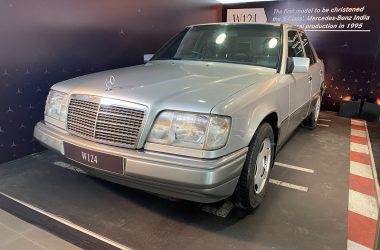
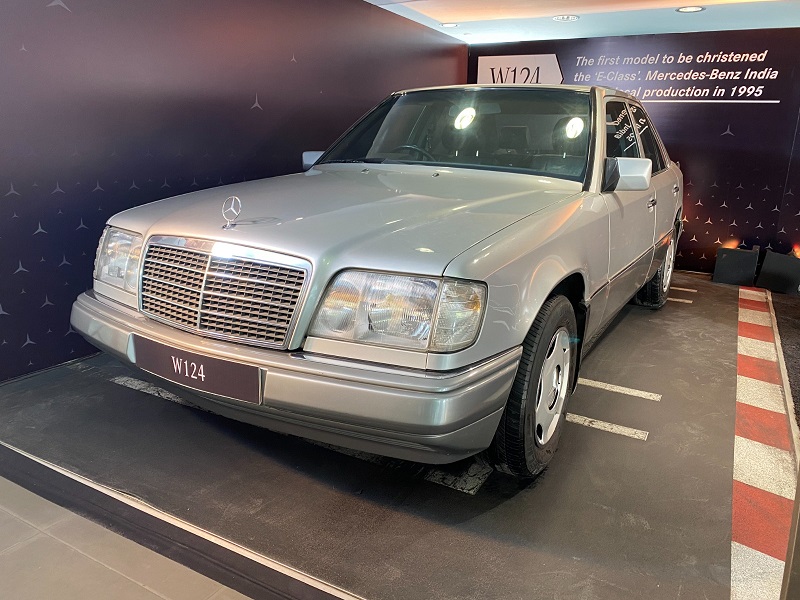
The car you’re looking at here is the 1995 facelift model of the first-generation E-Class, a machine that represents the peak of Mercedes’ “no compromise” era.
Origins of a Legend
The W124 was launched globally in 1985, but it was during the 1990s facelift years that the car reached its most refined form. This was also the moment Mercedes formally introduced the “E-Class” nameplate, replacing the older numeric badging tradition.
Back in the day, the E-Class was offered with petrol and diesel engines, priced in India between ₹19 lakh and ₹26 lakh ex-showroom—figures that sound modest today but were eye-watering at the time. The E250 diesel, featured here, sat at the top of the local hierarchy and quietly established itself as the thinking person’s luxury sedan.
Production of this generation ended in 1997, but the E-Class story didn’t stop there. Fast forward to today and the model is now in its sixth generation, with prices starting close to ₹78 lakh, proving just how far the brand—and the market—has evolved.
Design That Refused to Age
Penned by legendary Mercedes designer Bruno Sacco, the W124 follows a simple rule: timeless is better than trendy. Sacco famously believed that a Mercedes should never look embarrassing, even after a decade—and the W124 proves that point effortlessly.
The clean lines, upright stance and restrained proportions make it look dignified even today. Details like the single central windshield wiper, the bendable bonnet-mounted star, and the understated grille aren’t gimmicks—they’re statements of confidence.
Its 0.30 drag coefficient was genuinely impressive for the era, giving the car both aerodynamic efficiency and a sense of solidity at speed.
Built Everywhere, Including India
The W124 was truly global, assembled in countries such as Germany, Poland, South Africa, Mexico, Indonesia and Malaysia. In India, it was manufactured through a joint venture with Tata Engineering and Locomotive Company (TELCO)—a fascinating chapter in Indian automotive history when Mercedes luxury met Tata industrial muscle.
Dimensions and Road Presence
At 4.7 metres long, 1.7 metres wide and 1.4 metres tall, the W124 has classic executive-sedan proportions. It’s not flashy, but it commands respect. A 1510-kg kerb weight, rear-wheel drive layout and a long wheelbase give it a planted, reassuring feel on the road.
Steel wheels, all-disc brakes, and Michelin 205/65 R15 tyres may sound ordinary today, but back then this setup delivered outstanding ride comfort and durability—two qualities the W124 became famous for.
Engines: Built to Outlive Trends
Internationally, the W124 was offered with an astonishing range of powertrains—from sensible four-cylinders to silky inline-sixes and even thunderous V8s, including legendary AMG variants like the E60.
India received the dependable workhorse:
- 2.5-litre inline-5 diesel (OM605)
- 111 hp and 170 Nm
- 0–100 km/h in ~15 seconds
- Top speed: 190 km/h
- Real-world efficiency of around 10 km/l
It wasn’t fast, but it was unstoppable. Remarkably, this was also the first mass-production diesel car in the world to feature four valves per cylinder—a quiet technical milestone that perfectly sums up Mercedes’ engineering mindset.
Ride, Comfort and Build Quality
The W124 rides on independent suspension at all four corners, with a sophisticated multilink rear setup that still feels impressive today. Add hydraulically damped engine mounts, and you get a car that isolates occupants from the outside world with remarkable calm.
This was a vehicle trusted globally as taxis, ambulances, limousines and even commercial platforms—roles that demand extreme durability. In some markets, it was so desirable that it was extensively grey-imported into the United States, despite strict regulations.
Interior: Old-School Luxury Done Right
Step inside and you’re greeted by:
- Leather upholstery
- A leather-wrapped steering wheel
- A clear, analog instrument cluster
- Automatic climate control with dust filters
- Anti-dazzle mirrors
- A generous 413-litre boot
There are no flashy screens, no unnecessary drama—just solid materials, logical controls and the reassuring feeling that everything will still work decades later.
Safety Before It Was Fashionable
Long before safety became a marketing buzzword, the W124 offered:
- Dual airbags
- ABS
- Reinforced passenger safety cell
- Impact-absorbing bumpers
- Seatbelt pretensioners
- Central locking and emergency safety equipment
It was engineered not just to avoid accidents, but to protect occupants when things went wrong.
Reliability: The Stuff of Legends
The W124’s reputation for reliability is not exaggerated. According to surveys by the German Automobile Association, only 11 out of 1,000 four-year-old W124s experienced serious breakdowns. That statistic alone explains why so many of these cars are still on the road today.
Final Verdict
The Mercedes-Benz W124 E-Class is not merely an old luxury sedan—it is a symbol of an era when cars were built to last indefinitely, not just until the warranty expired.
Modern E-Classes are faster, smarter and packed with technology. But none quite capture the honesty, durability and mechanical integrity of the W124.
It wasn’t designed to impress neighbours—it was designed to survive them.
And that is precisely why, decades later, this classic E-Class remains one of the greatest executive sedans ever built.