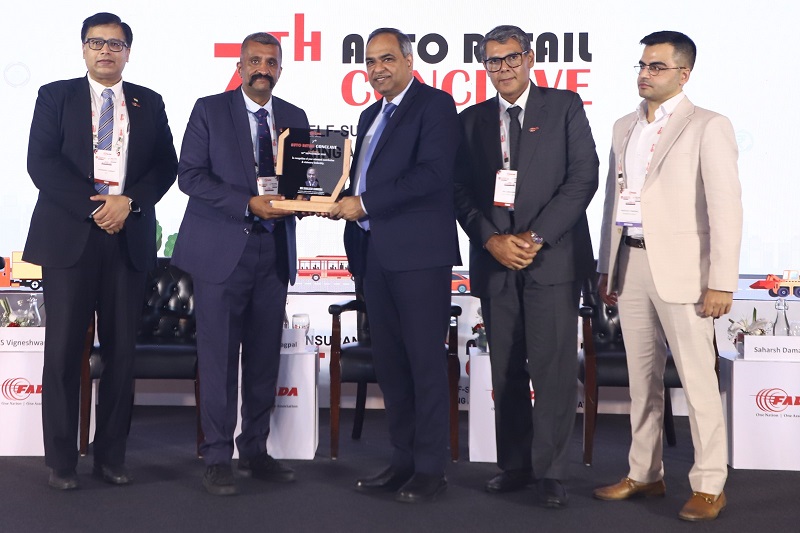
New Delhi – India’s auto retailers swapped car keys for conclave badges as the Federation of Automobile Dealers Associations (FADA) hosted its 7th Auto Retail Conclave, themed “Self-Sustaining Success: Transforming Auto Retail for Naya Bharat.” The event gathered more than 500 delegates, including dealer leaders, OEM giants, and policymakers, proving that in the business of mobility, the true horsepower lies in collaboration.
Ministers on a Mission: From Roads to Resilience
Union Minister for Road Transport & Highways, Nitin Gadkari, revved up the crowd with his trademark candour. He reminded the industry that India’s path to clean mobility isn’t a pit stop but a “continuous journey”—featuring everything from hydrogen-powered excavators to EV buses that hum louder than traffic jams in Karol Bagh. Gadkari confidently declared that India, already the world’s third-largest auto market, will “become No.1 in just five years” – a statement that had many dealers wishing they could pre-book that future spot like a hot-selling SUV variant.
Meanwhile, Union Minister for Heavy Industries & Steel, Shri H.D. Kumaraswamy, joined virtually to stress the role of dealerships as the “trusted face of mobility” for families across India. He noted that with 15,000 dealerships and 20,000 outlets employing nearly 50 lakh people, the retail sector doesn’t just sell cars—it powers the economy. In short, every time you haggle over floor mats, you’re helping fuel Atmanirbhar Bharat.
Dealers as the Unsung Heroes
FADA President, C.S. Vigneshwar, reminded everyone that auto retail in India isn’t just about selling vehicles—it’s about sustaining livelihoods for over 50 lakh people, anchoring investments of ₹20 lakh crore, and contributing a cool ₹3 lakh crore annually in taxes. “We’re three times bigger than all organized retail combined,” he said, ensuring that no one ever confuses car dealerships with your average supermarket chain.
Vigneshwar also didn’t shy away from tough truths—highlighting concerns over excessive inventory, wafer-thin margins, and GST 2.0 hiccups. His call for a Dealer Protection Act and fair OEM–dealer agreements was greeted with nods, applause, and possibly a few mental notes about calling their CAs.
Highlights: From CSR to DSS (and Not Just Alphabets)
- CSR with Speed: FADA unveiled a new CSR initiative aimed at providing immediate assistance to road accident victims—because saving lives is the ultimate service add-on.
- Dealer Satisfaction Study (DSS’25): Industry veterans debated dealer-OEM relationships in a panel moderated by none other than Hormazd Sorabjee. Spoiler: transparency and trust still sell better than any discount scheme.
- Women & Youth in the Driver’s Seat: With Women in FADA (WIF) and GenX initiatives, the conclave highlighted how inclusivity and fresh ideas are shaping the future of auto retail—proof that dealerships aren’t just old boys’ clubs anymore.
Gadkari’s Fireside Chat: Vision with a Touch of Petrolhead Passion
The session with Shri Nitin Gadkari, moderated by The Times of India’s Pankaj Doval, was part lecture, part stand-up act, and wholly inspirational. Gadkari urged dealers to embrace sustainable fuels and technologies, quipping that green mobility is not just a necessity but an “opportunity to make India a global automotive leader.” Dealers left wondering whether they should stock more hydrogen brochures or just invest in better coffee for long EV-charging customer waits.
A Conclave That Shifted Gears
From policy pushes to OEM-dealer hugs (metaphorical, mostly), the 7th Auto Retail Conclave was less about selling cars and more about selling India’s automotive dream. With ethics, economy, and environment steering the wheel, FADA reminded everyone that “Self-Sustaining Success” isn’t just a theme—it’s the fuel driving auto retail into Naya Bharat.