


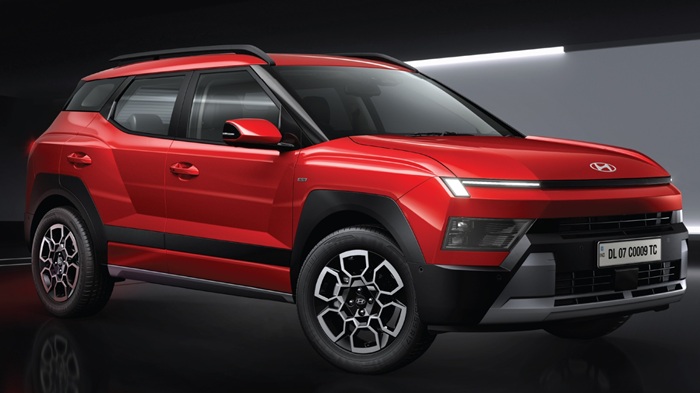
Gurugram: Hyundai Motor India Limited (HMIL) has revealed the engine specifications, transmission options and driving technologies of the upcoming Hyundai Bayon, ahead of its official India launch on October 26, 2026. The new SUV will feature a 1.5-litre four-cylinder petrol engine producing 115 PS, paired with either a six-speed manual transmission or an Intelligent Variable Transmission (iVT). Bookings are already open for ₹11,000 through authorised Hyundai dealerships and the company’s official website.
Positioned as an Intelligent Utility Vehicle, the Hyundai Bayon will introduce features including Dash Boost Mode, Sporty Drive Tech, paddle shifters and selectable driving modes. Hyundai says these technologies are designed to improve acceleration response, driving refinement and everyday usability across urban and highway conditions.
Hyundai Bayon Gets Proven 1.5-Litre Petrol Engine
Powering the Hyundai Bayon is the company’s naturally aspirated four-cylinder 1.5-litre MPi petrol engine, developing 84.4 kW (115 PS) of maximum power and 143.8 Nm (14.7 kgm) of peak torque.
Rather than introducing an entirely new powertrain, Hyundai has opted for an established engine already used across multiple models in its Indian portfolio.
According to HMIL, more than six lakh Hyundai vehicles equipped with this engine have been sold in India since 2020. The company points to this sales history as evidence of the powertrain’s customer acceptance and established track record.
The engine is designed to prioritise smooth power delivery and refinement, characteristics particularly relevant for customers navigating congested city roads and undertaking longer highway journeys.
Six-Speed Manual and Intelligent Variable Transmission Options
The Hyundai Bayon will be available with two transmission choices: a six-speed manual gearbox (6MT) and Hyundai’s Intelligent Variable Transmission (iVT).
The manual transmission will cater to buyers who prefer direct control over gear selection, while the iVT is intended to deliver smoother acceleration and greater convenience, particularly in stop-and-go traffic.
Hyundai says the iVT has been developed to balance driving efficiency with responsiveness, adapting its operation to different driving situations.
The automatic transmission will also support additional performance-oriented technologies intended to make acceleration more responsive when required.
Dash Boost Mode and Sporty Drive Tech Explained
Among the Bayon’s notable driving technologies are Dash Boost Mode and Sporty Drive Tech, both offered with the iVT transmission.
According to Hyundai, Dash Boost Mode provides an immediate improvement in acceleration response when additional performance is required, particularly during overtaking manoeuvres. The system is intended to help drivers accelerate more promptly without compromising the transmission’s emphasis on smooth operation.
Sporty Drive Tech, meanwhile, is designed to deliver a more engaging acceleration experience, with an emphasis on responsiveness and driver involvement.
Although Hyundai describes Dash Boost Mode as providing an instant power boost, it has not specified any additional engine output associated with the feature. The officially announced maximum engine output remains 115 PS.
Together, these technologies represent Hyundai’s attempt to make its automatic transmission feel more responsive during everyday driving, rather than focusing solely on outright performance figures.
Paddle Shifters and Three Selectable Drive Modes
The Hyundai Bayon will also feature steering-wheel-mounted paddle shifters, allowing drivers to influence transmission operation without taking their hands off the steering wheel.
Additionally, the SUV will offer three selectable driving modes: Eco, Normal and Sport.
Eco Mode is calibrated to prioritise fuel efficiency, making it suitable for routine commuting and situations where economical driving takes precedence.
Normal Mode provides a balanced combination of performance and efficiency, intended for everyday driving across varying road conditions.
Sport Mode delivers more responsive performance characteristics for drivers seeking a more engaging experience.
A dedicated steering-mounted Drive Mode button will allow drivers to switch between these settings conveniently.
The combination of paddle shifters, selectable drive modes and the iVT’s additional performance features is intended to provide drivers with greater flexibility in how the Bayon responds to different driving conditions.
Hyundai Emphasises Everyday Performance Over Power Figures
Commenting on the Bayon’s performance philosophy, Mr. Tarun Garg, Managing Director & CEO, Hyundai Motor India Limited, said:
“At Hyundai, we believe performance is not defined solely by power figures, but by how naturally and confidently a vehicle responds to the driver in everyday situations. With Hyundai Bayon, we have combined our trusted four-cylinder 1.5L MPi petrol engine with intelligent driving technologies to deliver a driving experience that feels smooth, responsive and engaging across a variety of road conditions. Technologies such as the Intelligent Variable Transmission (iVT), Dash Boost Mode, Sporty Drive Tech and selectable drive modes work seamlessly together to adapt to the driver’s needs and enhance confidence behind the wheel. Guided by our philosophy of ‘Intelligence That Moves,’ Hyundai Bayon delivers a refined and intuitive driving experience designed for the evolving expectations of Indian customers.”
The Bayon’s performance package reflects Hyundai’s emphasis on everyday drivability, particularly in a market where buyers increasingly expect automatic transmissions to deliver both convenience and reasonable responsiveness.
While the powertrain’s specifications are now confirmed, its real-world acceleration, fuel efficiency and transmission behaviour will become clearer once the vehicle undergoes independent testing.
Hyundai Bayon India Launch Date, Bookings and Deliveries
The Hyundai Bayon is scheduled to make its official Indian market debut on October 26, 2026.
Customers can currently reserve the SUV by paying a booking amount of ₹11,000 through authorised Hyundai dealerships or online at www.hyundai.co.in.
Hyundai has confirmed that deliveries are expected to begin during the festive season, with more detailed delivery timelines to be communicated at the launch.
The company has not disclosed the Bayon’s official prices in its latest announcement.
What the Hyundai Bayon Means for Indian Buyers
With its established 1.5-litre petrol engine, choice of manual and automatic transmissions, and a range of driver-focused technologies, the Hyundai Bayon appears to favour predictable performance and everyday practicality over headline-grabbing horsepower figures.
Its success, however, will depend on factors beyond the engine bay, including pricing, equipment, fuel efficiency and how convincingly its driving technologies perform on Indian roads.
As Hyundai prepares to unveil the Bayon on October 26, the SUV’s combination of familiar mechanical engineering and newer electronic driving features underlines a broader shift in the market: performance is increasingly being judged not merely by how quickly a vehicle accelerates, but by how comfortably and confidently it handles the demands of everyday driving.