


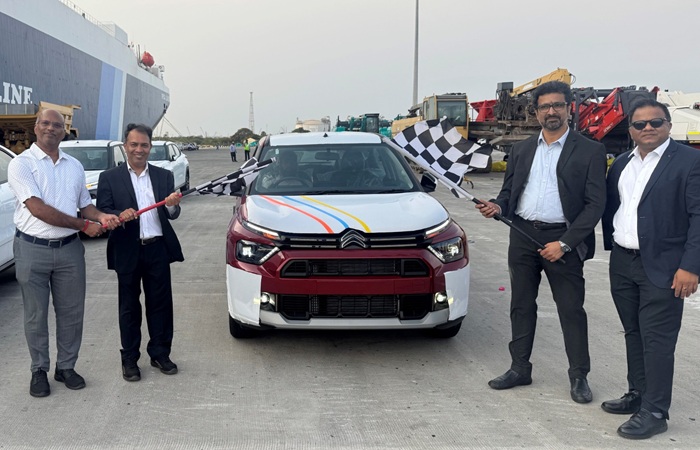
Chennai — Stellantis India has quietly hit a milestone that speaks volumes louder than a revving engine. The company has flagged off its first export shipment of the Citroën Basalt to South Africa, simultaneously crossing the landmark of 10,000 Citroën vehicles exported from India to the African nation. Not bad for a country that once exported mostly spices and software—now, it’s sending stylish SUV coupés across oceans.
The shipment, dispatched from Stellantis’ Chennai facility, marks the beginning of the Basalt’s international journey and underscores India’s growing importance in the global automotive value chain. More importantly, it signals that “Make in India” is no longer just a slogan—it’s increasingly becoming a shipping label.
At the heart of this export success lies Stellantis’ Smart Car platform, a product of Indian engineering prowess. Designed, developed and industrialised locally, the platform caters to both domestic and international markets, proving that Indian R&D is not just cost-effective but globally competitive. In simpler terms, these cars aren’t just made in India—they’re made for the world, with enough confidence to passport themselves abroad.
The milestone also reinforces the export-grade quality standards maintained at Stellantis India’s manufacturing facilities. As global markets become more discerning, consistency in quality and process discipline has become non-negotiable—and India seems to be ticking those boxes with increasing ease. Think of it as India graduating from “value-for-money” to “value-for-the-world.”
The inclusion of the Citroën Basalt in the export lineup is particularly significant. Positioned as India’s first mainstream SUV coupé, the Basalt blends design flair with practicality, tailored especially for emerging markets. Built on a platform that boasts up to 95 percent localisation, it reflects Stellantis’ strategy of creating scalable, adaptable products that resonate across geographies.
Shailesh Hazela, CEO and Managing Director of Stellantis India, highlighted that the Basalt’s export rollout strengthens India’s role as a competitive manufacturing and sourcing hub. He emphasized the company’s focus on building a resilient ecosystem—one that seamlessly integrates vehicles, components and supply chains with consistent quality delivery.
Beyond corporate milestones, the achievement aligns neatly with India’s broader economic vision. Stellantis’ export growth supports job creation, skill development and strengthens the country’s automotive ecosystem. In other words, every Basalt shipped out isn’t just a car—it’s a quiet ambassador of India’s manufacturing ambition.
As the Basalt begins its journey to South Africa, it carries more than just passengers in the future—it carries the story of a nation steadily shifting gears from local production to global domination. And if this momentum continues, “Made in India” might soon become the automotive world’s favourite badge of honour.