
If hatchbacks had personalities, the Honda Jazz would be that quiet, intelligent overachiever in class who never bragged—but always topped the exam. And the 2012 facelift of the second-generation Jazz? That was Honda at its most unapologetically premium phase in India, when buying a Honda wasn’t just a purchase—it was a statement.
Originally launched globally in 2001 and known internationally as the Honda Fit, the Jazz you see here belongs to the GE/GG generation—a car that wore multiple crowns, including the prestigious Japanese Car of the Year 2007 title and a consistent spot among Japan’s best-sellers. Designed by Daisuke Sawai and engineered under Kohei Hitomi, this wasn’t just a hatchback—it was a global phenomenon assembled across continents, from Japan to Brazil to India.
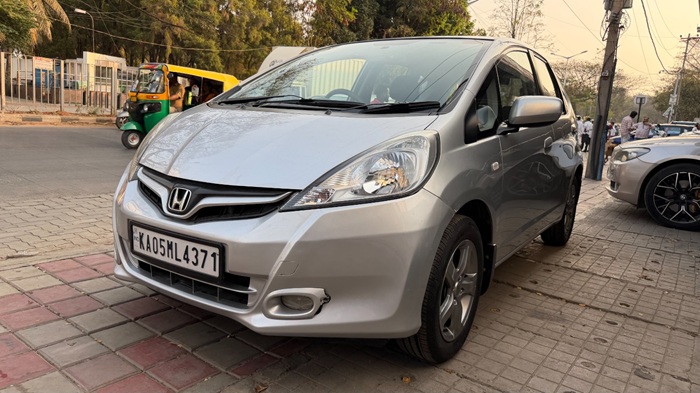
In India, however, the Jazz lived a slightly different life. It was offered only with a petrol engine, priced between ₹6.87 lakh and ₹7.50 lakh (ex-showroom), which, in early 2010s India, was essentially Honda saying, “If you want quality, you’ll have to pay for it.” And people did. Even today, you can spot enthusiasts hunting down well-kept examples—like this top-end X variant available for around ₹3.95 lakh—because once you drove a Jazz, settling for anything else felt like downgrading your life choices.
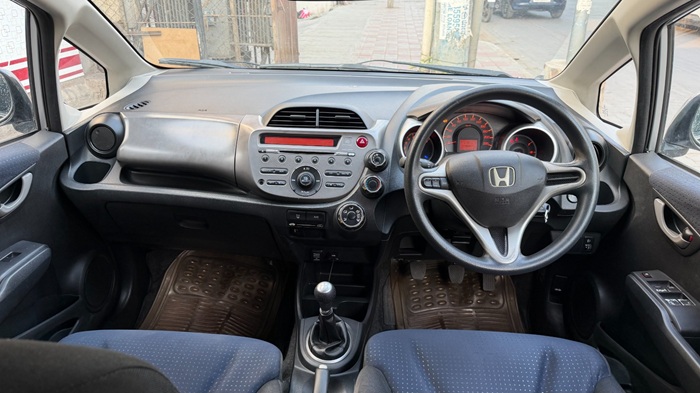
Visually, the Jazz followed what Honda called a “forward-leaning dynamic design,” which is a fancy way of saying it looks like it’s always ready to sprint—even when parked. The aerodynamic bumpers, body-coloured grille, and those slightly serious-looking halogen headlamps with height adjustment gave it a mature yet sporty face. The Alabaster Silver shade seen here is classy, but if you ask any Jazz enthusiast, the red colour on this car was nothing short of legendary—arguably one of the best reds ever offered on a hatchback.
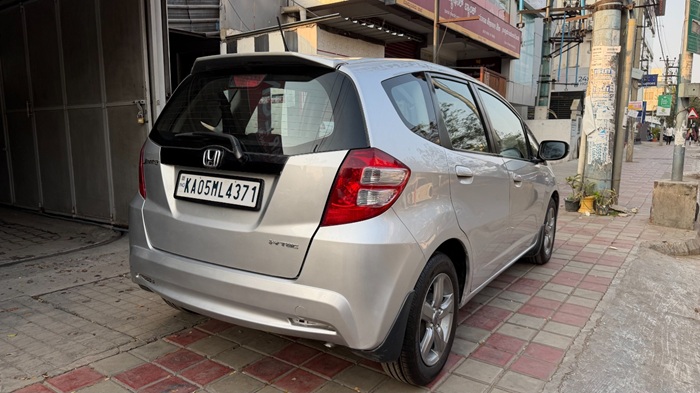
Despite being just 3.9 metres long, the Jazz had the road presence of a much larger car, thanks to its tall-boy stance and clever proportions. The 15-inch alloys wrapped in Goodyear Triplemax tyres, disc brakes at the front, and a tight 4.9-metre turning radius made it both stable on highways and nimble in city traffic. And let’s not forget that “gun-bullet-like” aerodynamic design—yes, that’s an actual phrase used—contributed to its impressive high-speed stability.
Step inside, and the Jazz reveals its true superpower: space. This is where it didn’t just compete—it embarrassed rivals.
The cabin, available in blue-black or beige-black upholstery, felt airy thanks to generous glass area and clever packaging. Honda’s legendary “Magic Seats” system allowed you to fold, flip, and configure the rear seats in ways that would make a Swiss Army knife jealous. Need to carry a bicycle? Done. Tall plants? Easy. Your friend’s questionable furniture purchase? The Jazz says, “Bring it on.”
Boot space stood at a generous 585 litres, expanding to a cavernous 1622 litres with the rear seats folded. In a hatchback. Let that sink in.
Then there were the small but delightful touches—multiple cup holders (seriously, hydration was clearly a priority), a storage box under the rear seat, and a driver’s seat with height adjustment. The steering was electrically assisted and collapsible, with tilt adjustment and mounted controls, making long drives effortless. Even the instrument cluster had a futuristic stereoscopic design, displaying everything from average fuel efficiency to range—features that felt ahead of their time.
Under the hood sat a 1.2-litre i-VTEC petrol engine, producing 88 horsepower and 110 Nm of torque. Now, those numbers may not sound thrilling today, but the way this engine delivered power was pure Honda magic. Thanks to the i-VTEC system, the engine adjusted valve timing based on driving conditions, giving you a smooth, efficient drive most of the time—and a surprising burst of enthusiasm when you pushed it. That moment when the engine suddenly wakes up? Enthusiasts fondly call it “VTEC kicking in,” and trust me, it’s addictive.
Paired with a 5-speed manual gearbox and drive-by-wire throttle, the Jazz felt responsive and eager. The suspension setup—McPherson struts at the front and a torsion beam at the rear—struck a fine balance between comfort and handling. Whether you were gliding over city potholes or cruising on highways, the Jazz remained composed, refined, and reassuring.
Safety was another area where the Jazz quietly outperformed expectations. It came equipped with dual airbags, ABS with EBD, brake assist, and Honda’s G-CON body structure designed to absorb impact efficiently. Add to that 5-star ratings from both NHTSA and Australian NCAP, and you had a hatchback that took safety as seriously as it took practicality.
But perhaps what truly sets this generation of Jazz apart is something less tangible—its build quality. Around 26% of its parts were imported, many directly from Japan, giving it a solidity and finesse that later models, built with cost-cutting in mind, struggled to replicate. Doors shut with a reassuring thud, materials felt durable, and everything—from buttons to panels—had that unmistakable Honda precision.
And this is where the story turns slightly philosophical. The Jazz came from an era when Honda in India was seen as a premium brand—alongside icons like the City, Civic, CR-V, and Accord. These were cars bought not just for utility, but for pride. Over time, as Honda chased volume and tried to compete with more aggressive pricing strategies from Korean and other Japanese brands, something changed. The focus shifted, compromises crept in, and the brand slowly drifted away from what made it special.
The Jazz, discontinued in India in 2014 (in this generation), remains a reminder of that golden era. An era when a hatchback could feel luxurious, when engineering took precedence over cost-cutting, and when driving a Honda meant you had arrived—both literally and metaphorically.
Even today, owners of this Jazz—and its sibling, the City—rarely let them go. Because cars like this don’t just transport you; they stay with you. They become part of your story.
In a market now flooded with feature-packed, aggressively priced options, the Jazz stands tall as a symbol of what happens when a company builds a car with passion rather than just a pricing strategy. It may not have had diesel engines, automatics, or flashy gimmicks in India, but what it did have was soul—and that’s something you can’t spec on a brochure.
And honestly, if you ever find a well-kept example of this Jazz, don’t overthink it. Just take a test drive. Be warned though—like many before you, you might end up stretching your budget… and happily so.