


New Delhi/Kharkhoda: Maruti Suzuki India Limited’s advanced vehicle manufacturing facility at IMT Kharkhoda in Haryana was inaugurated on Thursday by Prime Minister Narendra Modi and Japanese Prime Minister H.E. Sanae Takaichi through video conferencing during the India-Japan Joint Economic Forum in New Delhi.
Spread across 800 acres and supported by an integrated supplier park, the Kharkhoda facility currently has an annual production capacity of 0.5 million units. Maruti Suzuki plans to scale it up to one million units per year, making it one of the world’s largest vehicle manufacturing facilities at full scale. The project is expected to involve a total investment of ₹35,000 crore and create more than 21,000 jobs.
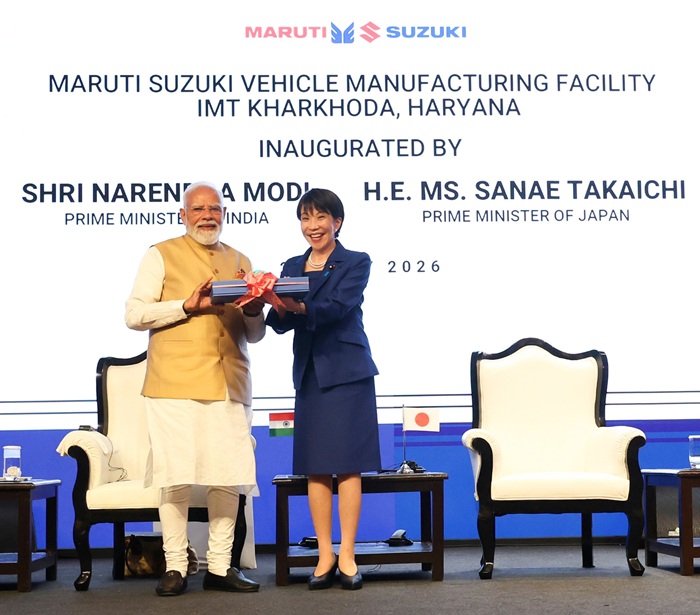
The inauguration marks a major milestone in Maruti Suzuki’s more than four-decade journey in India and adds another manufacturing pillar to the company’s ambition of reaching four million units in annual production capacity. It also underlines the continuing depth of the India-Japan industrial partnership, which has helped shape India’s passenger vehicle market for decades.
Toshihiro Suzuki, Representative Director and President, Suzuki Motor Corporation, and Hisashi Takeuchi, Managing Director and CEO, Maruti Suzuki India Limited, were present at the event along with senior dignitaries from the Government of India.
On the occasion, Toshihiro Suzuki said, “It is a great honour for Suzuki group today as its most advanced car manufacturing facility at Kharkhoda, Haryana has been inaugurated by Hon’ble PM Narendra Modi and H.E. Sanae Takaichi. From current capacity of half a million units, the plant will be further scaled to one million units, making it one of the largest car plants in the world. It is a testament to the success of India-Japan partnership and ‘Make in India’ initiative. With favourable policy environment under Hon’ble PM Modi’s leadership, Suzuki is accelerating investments, employment, exports and technologies towards Viksit Bharat journey.”
Suzuki also highlighted India’s growing role within the Suzuki Group, pointing to the company’s export strategy and electric vehicle plans.
“Over the years, India’s importance has grown significantly within the Suzuki Group. Suzuki’s first Battery Electric Vehicle, the e Vitara, is manufactured exclusively at Maruti Suzuki’s Gujarat plant, for exports to 100 countries globally. Thanks to exports of Made in India cars, Suzuki has become the largest car importer in Japan, one of the most demanding automobile markets. This shift is a strong reflection of how ‘Make in India, Make for the World’ is unfolding in practice, demonstrating growing global trust in India’s quality, capability, and advancement in manufacturing.”
The Kharkhoda plant has been developed on the ‘Suzuki Smart Factory’ concept, using advanced digital technologies to allow real-time visualisation of operations. The company said the approach is aimed at improving safety, quality and productivity while reducing energy consumption across manufacturing processes. In plain factory-floor terms, the machines will be working smarter, while humans still get to keep the final word.
The facility also integrates Industry 5.0 practices, including human-aware collaborative robots, or COBOTS, designed to enable safer and more efficient human-machine collaboration. The company said these systems will support global benchmarks in quality and operational excellence.
Sustainability is a key element of the plant’s design. Maruti Suzuki said 100% of the facility’s electricity requirement is being met through renewable energy, including solar power and green power procurement. The plant currently has an installed solar capacity of 20 MWp, which is planned to rise to 70 MWp by 2030. A 10 TPD biogas plant and a 1 MWh Battery Energy Storage System are also being installed.
The Kharkhoda facility operates as a zero liquid discharge plant, with 100% recycling of water. Nearly two-thirds of its total water requirement is being met through recycled water and rainwater harvesting, reflecting the rising importance of resource management in large-scale manufacturing.
To reduce congestion and fuel consumption during vehicle transportation, Maruti Suzuki also plans to establish an in-plant railway siding at Kharkhoda. Similar railway sidings are already operational at the company’s manufacturing facilities in Manesar, Haryana, and Hansalpur, Gujarat.
Beyond manufacturing, the company said it is implementing community development projects in 10 villages near the Kharkhoda facility. These initiatives cover education, community infrastructure, healthcare and sanitation, and are being planned in consultation with local community leaders.
Maruti Suzuki has also set up four Japan-India Institutes for Manufacturing as part of a collaborative initiative between the Governments of India and Japan. Since inception, 2,600 students have been trained across the Maruti Suzuki-operated institutes. The company is also planning student hostel facilities at JIM Sonipat and Manesar to support residential training needs.
The Kharkhoda facility arrives at a time when India is positioning itself as a major global manufacturing and export hub. For Maruti Suzuki, the plant is not just another production site; it is a statement of scale, technology and long-term confidence in India’s automotive future.
Maruti Suzuki Manufacturing Footprint
| Plants & Capacity break up | Gurugram – 0.5 million units Manesar – 0.9 million units Hansalpur – 0.75 million units Kharkhoda – 0.5 million units |
| Expected capacity by FY 2026-27 | 2.9 million units after the commissioning of fourth production plant at Hansalpur. |