

British engineering giant returns to Bonneville Salt Flats 20 years after Dieselmax triumph, this time powered by hydrogen
Staffordshire, United Kingdom: Twenty years after proving that diesel-powered machines could be blisteringly fast, JCB is preparing to rewrite the record books once again—this time with hydrogen.
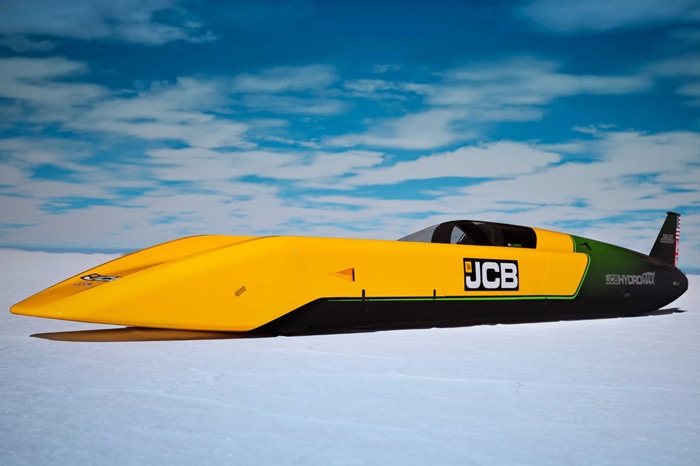
The British construction equipment manufacturer has unveiled plans to chase a new land speed record using the JCB Hydromax, a futuristic 32-foot-long hydrogen-powered streamliner designed to exceed 350 mph (563 km/h). If successful, the attempt could dramatically raise the bar for hydrogen-powered vehicles worldwide and demonstrate that hydrogen combustion engines can be about much more than powering construction equipment.
After all, not many companies decide to showcase a digger engine by putting it in a missile-shaped race car and sending it across a salt desert at aircraft-like speeds. But then again, JCB has never been accused of lacking ambition.
A New Chapter After Dieselmax
The project comes exactly two decades after the legendary JCB Dieselmax stunned the motorsport world in 2006. Driven by renowned speed record holder Wing Commander Andy Green OBE, the diesel-powered machine achieved a world record speed of 350.092 mph, a benchmark that remains unbeaten to this day.
Now Green is back behind the wheel, this time piloting the hydrogen-powered Hydromax at Utah’s famous Bonneville Salt Flats, one of the most iconic venues in land speed racing.
The project is being developed with support from engineering specialists Prodrive and Ricardo, combining British expertise from multiple sectors.
Powered by Hydrogen, Built for Speed
At the heart of the Hydromax are two production-based JCB hydrogen internal combustion engines, each producing approximately 800 horsepower, delivering a combined output of 1,600 bhp.
Unlike hydrogen fuel-cell vehicles, the Hydromax uses hydrogen combustion technology, a field where JCB has invested heavily over the last five years. The company has committed around £100 million toward hydrogen engine development, and hydrogen-powered construction equipment has already begun rolling off JCB production lines.
Power from the twin engines will be sent to all four wheels through a sophisticated twin-transmission and clutch arrangement designed specifically for the record attempt.
The engineering team has also spent years refining aerodynamics, stability, traction control systems and structural components to ensure the car remains planted while travelling at speeds most commercial aircraft would find respectable.
Lord Bamford: Hydrogen Can Deliver More Than Sustainability
JCB Chairman Lord Anthony Bamford, who has championed the company’s hydrogen strategy, believes the record attempt serves a much larger purpose than simply chasing numbers.
“Britain has a proud heritage of setting speed records and, as a British company, I’m excited to challenge for a new one using hydrogen. This is not just about speed – it’s about showcasing the world-class engineering talent we have here in the UK and the robustness of our new hydrogen engines.”
Reflecting on the Dieselmax project, he added:
“JCB Dieselmax was always a bit of an unusual idea – but it proved a point. Putting an advanced engine into a land-speed car showed the world what it could do in a way a digger never could. It’s the same thinking with hydrogen today. If you’re serious about emissions, you have to be serious about hydrogen – and a land-speed project is the perfect way to prove it.”
And what speed is JCB targeting?
“We intend to beat 350 mph.”
Simple. No pressure.
Andy Green Ready for Another Record Run
For Andy Green, the challenge represents another opportunity to demonstrate the capabilities of British engineering.
Green, who still holds the overall land speed record at 763.035 mph and remains the only person to break the sound barrier on land, believes the Hydromax has significant advantages over its diesel predecessor.
“The JCB Hydromax car is lighter, more powerful and faster than its predecessor of 20 years ago. Once again, we’re going to show the world just how good British engineering and technology really is.”
He added:
“This August we’re going to smash the hydrogen-powered vehicle record in the world’s fastest—and most exciting—zero-emissions vehicle. I can’t wait.”
Eyes on Multiple Records
The existing hydrogen internal combustion vehicle speed record stands at 185.5 mph, while hydrogen fuel-cell vehicles have reached 303 mph. The electric vehicle land speed benchmark currently stands at 342 mph.
With a target beyond 350 mph, JCB is aiming not merely to break records but to obliterate them.
Testing will begin in the United Kingdom before the team travels to Bonneville SpeedWeek in August. Following SpeedWeek, the Hydromax team will remain at Bonneville to pursue officially recognised records governed by the Fédération Internationale de l’Automobile (FIA).
Speed Remains Part of JCB’s DNA
The Hydromax project continues a long tradition of record-breaking machines from JCB. In 2019, the company claimed the title of the world’s fastest tractor with the JCB Fastrac, achieving 135.191 mph. Earlier, in 2014, the JCB GT became the world’s fastest backhoe loader at 72.58 mph.
Now, with hydrogen technology taking centre stage, JCB is preparing for perhaps its most ambitious challenge yet.
For a company best known for yellow construction equipment, turning hydrogen-powered digger engines into a 350-mph land missile may sound unconventional. But if history has taught us anything, it is that betting against JCB when speed records are involved is probably not a wise idea.
All eyes will now be on the Bonneville Salt Flats this August, where JCB hopes to prove that the future of high-performance engineering may well be powered by hydrogen.