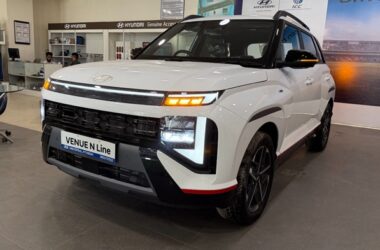
If there’s one car that walks into the compact SUV party wearing sneakers instead of loafers, it’s the Hyundai Venue N Line. Not because it’s the fastest machine in the room—but because it thinks it is, and honestly, that confidence alone deserves applause.
Let’s dive into this slightly mischievous, slightly sporty, and very urban Indian crossover that has decided regular commuting is simply too boring.
The story begins in 2022, when Hyundai decided that India didn’t just want practicality—they wanted a little attitude. Fast forward to 2026, and the second-generation Venue N Line arrives with sharper styling, more tech, and just enough performance tweaks to make your daily office run feel like a qualifying lap (minus the boss chasing you, hopefully).
Priced between ₹10.65 lakh and ₹15.58 lakh (ex-showroom), the top-spec N10 DCT Turbo variant you’re looking at sits proudly at the top, wearing its sporty badge like a gym membership it actually uses.
Built right here in India on Hyundai-Kia’s versatile K1 platform—the same architecture underpinning cars like the Hyundai Grand i10 Nios and Kia Sonet—the Venue N Line proves that performance aspirations don’t necessarily require a completely new platform… just the right amount of engineering drama.
Design: Gym-Ready, Instagram-Approved
At first glance, the Venue N Line doesn’t scream performance—it smirks.
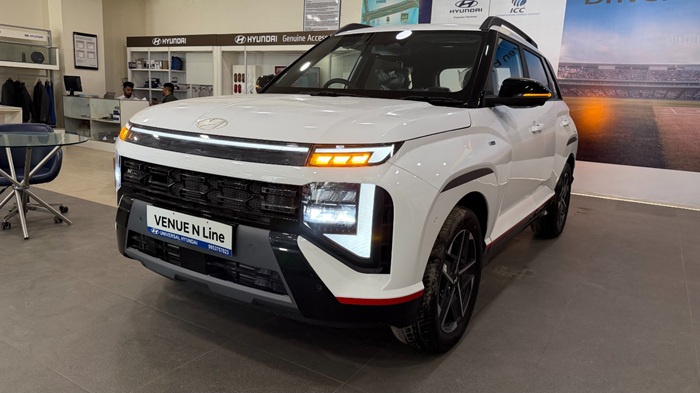
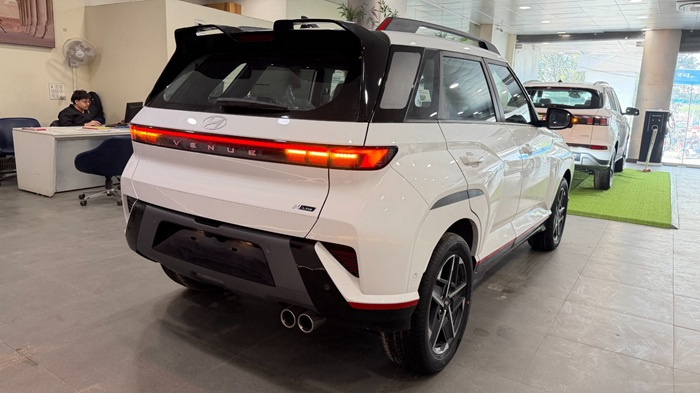
You get a dark chrome radiator grille, aggressive red accents, and those twin-tip exhausts that subtly say, “Yes, I’m different.” The quad-beam LED headlamps with sequential indicators and horizon-style LED DRLs give it a premium, almost futuristic identity.
The 17-inch diamond-cut alloys with N badging and red brake calipers add just the right amount of sportiness—like wearing red sneakers with a black suit. Questionable? Maybe. Stylish? Definitely.
Dimensions remain city-friendly at 4 metres long, but with 1.8 metres width and SUV stance, it carries a planted look. Add skid plates, roof rails with red highlights, and chunky cladding—and suddenly, your grocery run feels like an off-road expedition (even if the toughest terrain you’ll face is a mall parking ramp).
Interior: Sporty Lounge Meets Tech Lab
Step inside, and Hyundai clearly had one goal: make sure you forget this is a sub-4m SUV.
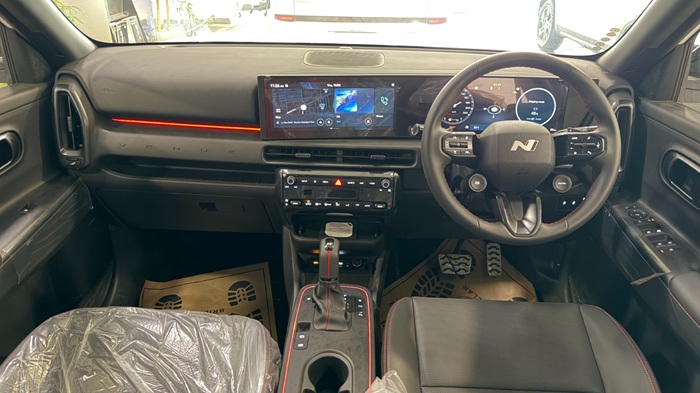
Dual 12.3-inch panoramic displays dominate the dashboard, powered by NVIDIA’s connected cockpit system. It’s fast, responsive, and packed with features—wireless Android Auto, Apple CarPlay, voice commands (over 400 of them!), and even ambient sounds of nature… because traffic jams apparently need background music.
The black leatherette upholstery with N branding, ambient lighting, and sporty metal pedals give it a youthful vibe. There’s even an aroma diffuser—because why should luxury sedans have all the good smells?
Front ventilated seats are a blessing in Indian summers, while the Bose 8-speaker system ensures your playlist sounds better than your engine (not a complaint, just an observation).
Rear seats offer decent space with reclining function, and a 375-litre boot ensures weekend trips are well within reach—provided you pack smart and don’t carry your entire wardrobe.
Performance: Turbocharged Enthusiasm
Under the hood lies a 1.0-litre, 3-cylinder turbocharged petrol engine—Hyundai’s well-known Kappa II unit—producing 118 hp and 172 Nm.
On paper, it’s not exactly a track monster. But paired with a 7-speed DCT, it delivers enough punch to keep things interesting in city traffic and occasional highway sprints.
Drive modes—Eco, Normal, and Sport—change the car’s character noticeably. Sport mode sharpens throttle response and makes the gearbox hold gears longer, giving you that “I might be late, but I’ll look fast” feeling.
Fuel efficiency remains respectable at around 18 kmpl (manual) and 20 kmpl (automatic), proving that performance and practicality can coexist… like chai and biscuits.
The suspension setup—McPherson strut at the front and torsion beam at the rear—has been tuned slightly stiffer for the N Line, offering better handling without sacrificing too much comfort. It’s not a hot hatch, but it corners with confidence and doesn’t feel nervous at speed.
Technology & Safety: Smarter Than Your Smartphone (Almost)
Hyundai has basically thrown its entire tech catalogue into the Venue N Line.
You get OTA updates for 20+ controllers, meaning your car evolves over time—like a smartphone, but thankfully without annoying storage warnings.
ADAS Level 2 features under Hyundai SmartSense include everything from forward collision avoidance to blind-spot monitoring and adaptive cruise control with stop & go. In Indian traffic, this is less about autonomy and more about assisted survival.
Safety is comprehensive with 6 airbags, ESC, VSM, TPMS, ISOFIX mounts, and more acronyms than a government policy document.
Ownership: Peace of Mind, Extended Warranty Style
Hyundai offers a 3-year unlimited km warranty, extendable up to 7 years/1.4 lakh km. Add to that 10 years of roadside assistance, and you’re basically covered longer than some friendships.
With over 7 lakh units sold and annual sales of around 1.2 lakh units, the Venue has already proven its reliability and popularity in India.
Verdict: Sporty Enough to Matter, Sensible Enough to Buy
The Hyundai Venue N Line isn’t trying to be a full-blown performance SUV—and that’s exactly why it works.
It’s for buyers who want a little extra spice in their daily commute without sacrificing comfort, efficiency, or practicality. It’s the automotive equivalent of adding extra masala to your Maggi—not necessary, but highly recommended.
Sure, it won’t outrun sports cars. But it will outrun boredom—and in today’s traffic, that might just be the bigger victory.
In conclusion, the Venue N Line is not about outright speed. It’s about feeling faster than you actually are… and doing it with style, tech, and just the right amount of attitude.