When Maruti Suzuki decided it was finally time to plug itself into the electric future, it didn’t simply dip a cautious toe into the EV waters—it drove straight in with a fully charged crossover called the Maruti Suzuki e Vitara. Launched in 2026, this first-generation electric SUV represents a significant turning point for India’s largest carmaker. For decades, Maruti Suzuki mastered the art of affordable petrol mobility, but now it has added volts, kilowatts, and regenerative braking to the recipe. The result is a car that attempts to carry Maruti’s reliability and practicality into the electric age—while also looking like it just stepped out of a sci-fi design studio.
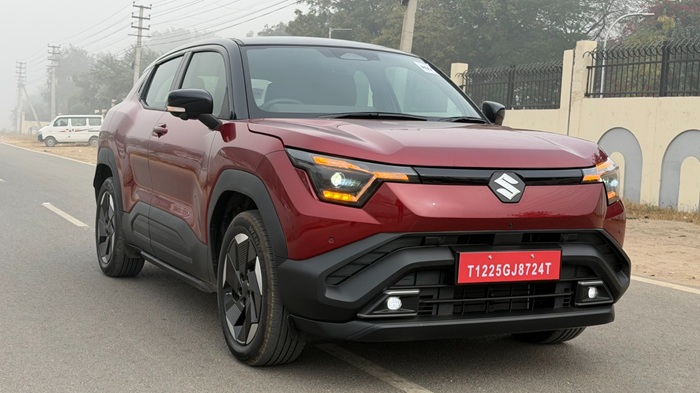
The e Vitara is not just another SUV with batteries stuffed underneath. It is Maruti Suzuki’s first fully electric SUV, and naturally, expectations were sky-high. Prices start at around ₹16 lakh ex-showroom and stretch to roughly ₹20 lakh for the fully loaded Alpha dual-tone variant you see here. That places it squarely in the rapidly growing mid-size EV segment, where practicality matters as much as range anxiety. Interestingly, the same car also travels the world wearing a different badge, as Toyota sells it internationally as the Toyota Urban Cruiser Ebella. Both models roll out of the same production facility in Gujarat, from where they are also exported to Europe and several global markets.
Internally, the e Vitara carries the codename PA2AS, which sounds less like an SUV and more like a classified government satellite program. But beneath the mysterious name lies a modern EV built on the Heartect electric skateboard platform—a dedicated architecture engineered to improve structural rigidity and lower the centre of gravity. This is the same base shared with its Toyota sibling, developed through Suzuki and Toyota’s long-standing collaboration. The design philosophy is called “Crafted Futurism,” which, if translated loosely, means geometric shapes, sharp surfaces, and enough angular lines to make origami artists proud. Designers Kimitoshi Sato, Takashi Hayashida and Sumio Ono have clearly taken inspiration from the Suzuki eVX concept, turning its futuristic sketchbook ideas into something that can survive Indian potholes.
From the front, the e Vitara has an unmistakably modern face. A smart grille with adaptive shutters helps improve aerodynamics, while the automatic LED projector headlamps come with NEXTre’ 3-Point Matrix LED DRLs, adaptive high-beam and auto headlamp levelling. LED fog lamps sit lower down, while rain-sensing blade-design wipers sweep across an acoustic infrared-cut windshield designed to reduce cabin heat. Electrically adjustable outside mirrors fold automatically and house both turn indicators and cameras. It’s all very sophisticated, and frankly quite impressive for a brand that once sold the humble 800.
Dimensionally, the e Vitara measures about 4.3 metres in length, 1.8 metres in width and 1.6 metres in height, with a turning radius of 5.2 metres. Ground clearance stands at 185 mm, which means it can still deal with Indian speed breakers that occasionally resemble Himalayan terrain. The kerb weight is around 1,800 kilograms—inevitable when you’re carrying a large battery pack—and the SUV can even tow up to 750 kg if needed. Wheel arches are extended, black side mouldings add visual muscle, and the SUV rides on stylish 18-inch alloy wheels with aero garnish. These are wrapped in 225/55 R18 MRF Wanderer Ecotred tyres, while disc brakes at both ends ensure stopping power keeps pace with the electric punch.
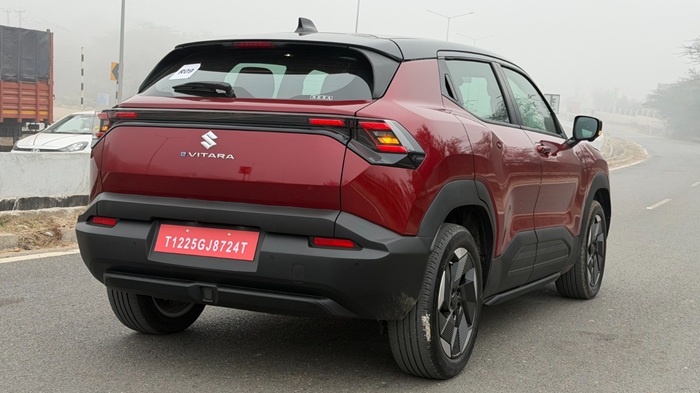
The rear of the car continues the futuristic theme with NEXTre’ 3-Point Matrix LED tail lamps, a rear wiper with washer, and dark green tinted glass in the doors. The Opulent Red colour you see here suits the design particularly well, although buyers can also choose from blue, green, silver, white, grey and black. Dual-tone variants come with a contrasting black roof that adds a sporty touch.
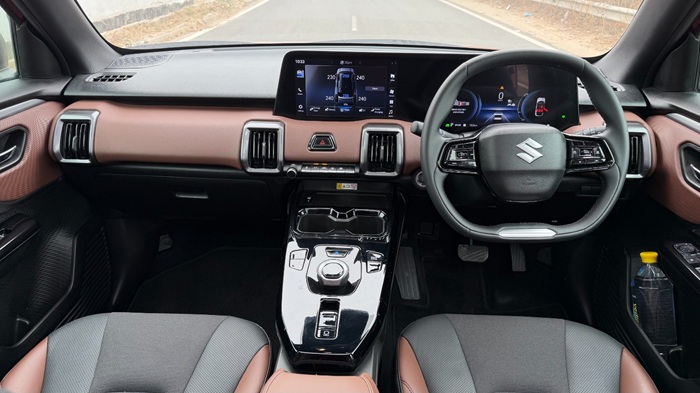
Step inside and you are greeted by a cabin that is both familiar and futuristic. The interior uses a soft-touch dual-tone theme with 3D patterned door trims and a mix of synthetic leather and fabric upholstery. Because there is no traditional transmission tunnel, the floor is flat, which makes the cabin feel surprisingly spacious. Ambient lighting and LED footwell illumination add a premium vibe, while LED reading lamps ensure passengers can pretend to read something important while actually scrolling Instagram.
Comfort has clearly been a priority here. The rear seats recline in ten steps and slide forward or backward, while the 40:20:40 split folding mechanism allows flexibility for cargo. Boot capacity stands at 306 litres, expanding to 562 litres with the seats folded. Up front, the driver enjoys a 10-way power-adjustable seat with ventilation, while the steering wheel adjusts for tilt and telescopic reach. The polygonal two-spoke steering wheel, wrapped in synthetic leather, controls volume, voice commands and the digital cluster.
Technology is where the e Vitara truly embraces the modern era. A 10.1-inch touchscreen infotainment system supports navigation, wireless Android Auto, Apple CarPlay, Bluetooth and the Hi Suzuki voice assistant. It also integrates Suzuki Connect services, allowing owners to interact with the car remotely via smartphone. The digital instrument cluster measures 10.25 inches and presents information in crisp detail. Meanwhile, music lovers will appreciate the eight-speaker Harman Infinity sound system complete with subwoofer and amplifier—perfect for listening to retro Bollywood tracks while silently gliding through traffic.
Connectivity goes deeper with the Suzuki Connect app, which offers features such as geofencing, valet alerts, remote charging control, AC scheduling, stolen vehicle tracking and vehicle location sharing. There is even smartwatch and Alexa connectivity, meaning you can technically start pre-cooling the cabin using voice commands while still brushing your teeth.
Under the floor sits the heart of the electric system: a 61 kWh lithium ferrophosphate battery supplied by BYD’s FinDreams division. This powers a three-phase AC permanent magnet synchronous motor producing 171 horsepower and 193 Nm of torque. Top speed is limited to 150 kmph, and the claimed range is an impressive 543 km. For buyers looking to save some money, a smaller 49 kWh battery option delivers 141 horsepower and a 440 km range. The battery pack is IP67 rated for water and dust resistance, and it is protected by advanced thermal management with low-ion coolant. It can tolerate temperatures ranging from minus 30 to plus 60 degrees Celsius—handy if your road trip involves both Ladakh and Rajasthan.
Charging times are reasonably practical. Using the 7.4 kW AC charger included with the car, the battery reaches 90 percent in about nine hours. An 11 kW AC charger reduces that to roughly five and a half hours, while DC fast charging can take the battery from zero to seventy percent in about forty-five minutes. Maruti even bundles a 3 kW portable charger, a 7.4 kW wall box charger and one year of complimentary charging access. For those who prefer innovative ownership models, a Battery-as-a-Service option brings the entry price down to around ₹11 lakh, with battery usage billed at roughly ₹3.99 per kilometre.
Driving the e Vitara feels distinctly modern. Three drive modes—Eco, Normal and Sport—adjust throttle response and efficiency. Snow mode improves traction on slippery surfaces, while regenerative braking can be adjusted across three levels. The easy-operation pedal system allows one-pedal driving in traffic, making city commuting almost relaxing—something rarely said about Indian roads.
Safety has also been taken seriously. The SUV has received four stars from Euro NCAP and five stars from Bharat NCAP. The structure uses around 60 percent high-tensile steel, and safety equipment includes seven airbags, electronic stability control, hill hold assist, multi-collision braking and tyre pressure monitoring. Advanced driver assistance systems bring features like automatic emergency braking, lane keep assist, blind spot monitoring and adaptive cruise control.
In many ways, the Maruti Suzuki e Vitara represents a fascinating moment in India’s automotive evolution. It combines the practicality and value that made Maruti famous with the technology and sustainability demanded by the electric era. It may not be the most radical EV in the world, but it is arguably one of the most important—because when India’s biggest carmaker goes electric, the entire market pays attention.
And if history has taught us anything, it’s this: when Maruti enters a segment, it rarely does so quietly. The e Vitara might be silent on the road, but its arrival speaks volumes about the future of mobility in India.