
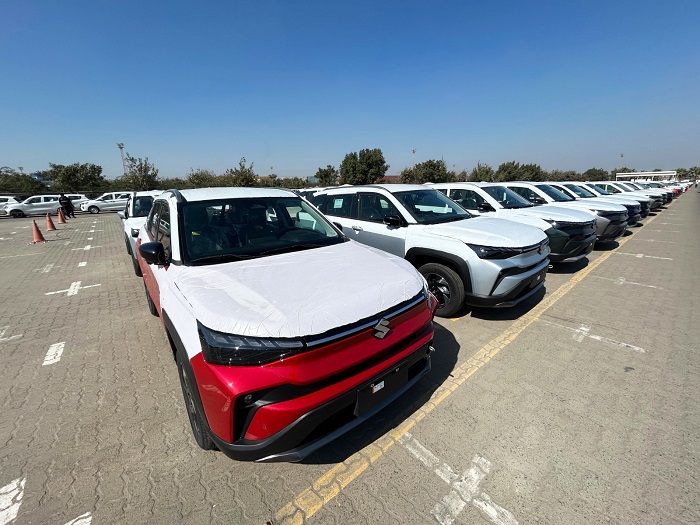
New Delhi: If you thought your new car always arrives by truck, Maruti Suzuki just rewrote that journey — with a railway timetable. In a landmark green logistics milestone, Maruti Suzuki India Limited dispatched over 5.85 lakh vehicles by rail in calendar year 2025, marking its highest-ever annual rail dispatch and an 18% jump over the previous year.
The shift isn’t just operational — it’s environmental. By moving more cars on trains instead of highways, the company says it avoided 87,904 metric tonnes of CO2e emissions and saved over 68.7 million litres of fuel. That’s roughly equivalent to telling tens of thousands of fuel tankers: “You can take the year off.”
Rail Share Climbs From Side Track to Fast Track
What began as a modest logistics experiment has turned into a full-fledged transport strategy. Maruti Suzuki’s rail dispatch share has grown more than fivefold — from 5.1% in 2016 to about 26% in 2025. In absolute numbers, rail-based dispatch volumes have surged over 7.5 times, from nearly 77,000 vehicles in 2016 to today’s 5.85 lakh+ units.
The result: fewer car carriers clogging highways, lower fuel consumption, and a quieter carbon footprint — even if the trains themselves are anything but quiet.
Landmark Year With Landmark Rail Moments
Highlighting the achievement, Hisashi Takeuchi, MD & CEO, Maruti Suzuki India Limited, said 2025 marked the company’s strongest year yet for rail logistics.
He noted two standout milestones:
- The inauguration of India’s largest automobile in-plant railway siding at the Manesar facility
- The first-ever rail dispatch of vehicles to the Kashmir Valley via the Chenab rail bridge, the world’s highest railway arch bridge — proving that even hatchbacks enjoy a good mountain view.
Takeuchi added that Maruti Suzuki aims to increase rail-based vehicle dispatches to 35% by FY 2030–31, aligning with India’s broader net-zero 2070 ambition.
Circular Mobility: From Factory Floor to Final Mile
Rail logistics is part of Maruti Suzuki’s broader sustainability framework called “Circular Mobility.” The approach focuses on reducing carbon impact across the entire vehicle lifecycle — from design and manufacturing to transportation and end-of-life vehicle management.
In logistics specifically, the company has been an early mover:
- First automobile manufacturer in India to obtain an AFTO (Automobile-Freight-Train-Operator) license in 2013
- Transported over 28 lakh vehicles by rail since FY2014-15
- Built a hub-and-spoke rail network covering 22 destinations and 600+ cities
- Currently operates 45+ flexi-deck rakes, each capable of carrying around 260 vehicles per trip
In 2025 alone, 53% of total rail dispatches originated from in-plant railway sidings at Gujarat and Manesar, reducing the need for first-leg road transport as well.
When Cars Prefer Window Seats
With Indian highways getting busier each year, Maruti Suzuki’s rail push shows how logistics can become a climate lever — not just a cost center. For customers, it may not change the delivery SMS. But behind the scenes, more cars are now arriving with a platform number instead of a truck number.
And somewhere out there, a freight train is proudly saying: “I don’t just carry coal and containers — I carry your next car.” 🚆🚗