


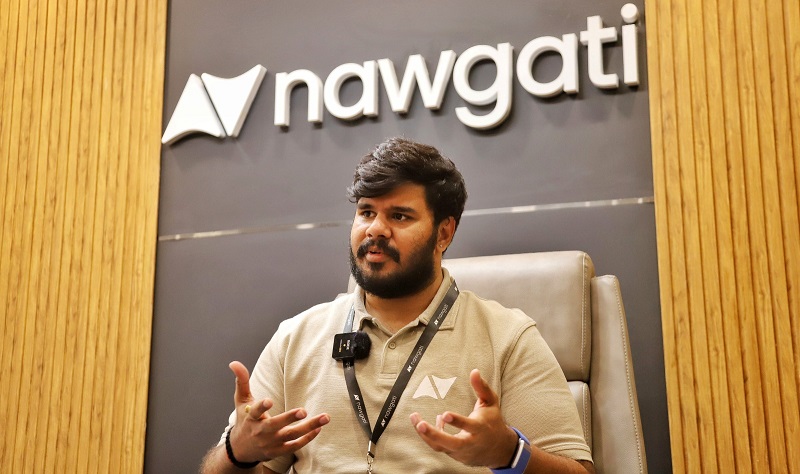
At just 20, while most college students were juggling exams and hostel life, Vaibhav Kaushik was busy reshaping India’s fueling ecosystem. What began as a casual chat with a cab driver about long queues at petrol pumps became the spark for Nawgati—India’s first fuel-agnostic forecourt intelligence platform that’s redefining how the nation fuels and charges its vehicles.
As the Co-founder and CEO of Nawgati, Vaibhav’s story is one of relentless curiosity, youthful ambition, and an unshakable belief that technology can fix even the most “everyday” of inefficiencies. From late-night coding sessions at BITS Pilani to pitching on Shark Tank India, and now partnering with industry giants like MGL, IGL, and GAIL, Vaibhav’s journey reflects the spirit of India’s new-age entrepreneurs—bold, data-driven, and fuelled by purpose.
In this exclusive conversation, he opens up about the spark behind Nawgati, the challenges of balancing college life with entrepreneurship, the lessons from Shark Tank, and his vision for transforming India’s fueling and EV charging landscape into a seamless, intelligent experience for all.
Q1. You were just 20 when you started Nawgati. What sparked the idea, and how did that one conversation with a cab driver evolve into India’s first fuel-agnostic platform?
Coming up with the idea of Nawgati was not a mere coincidence for me. I had been traveling a lot, using taxi services like Ola and Uber, back then, to commute. During that time, not only did I experience the problem firsthand, but after speaking with the cab drivers, I realised the intensity of the problem. The drivers used to spend at least an hour, and sometimes even more, in a fuel station line to fill up their vehicles, which cost them about 10% of their daily earnings. And, if one driver was feeling this way, I wondered what thousands of other drivers across the country were feeling, too.
That conversation made me look at fueling differently altogether. It was then that I reached out to my now co-founders, Aalaap Nair and Aryan Sisodia, about how we could utilize our knowledge and skills to introduce technology into a traditionally run industry, aiming to improve the efficiency of fuel stations and forecourt operations.
We started thinking, what if we could optimize this entire process, not just for petrol or diesel, but for any kind of fuel? That’s how Nawgati was born: with the idea of being fuel-agnostic from the very beginning.
Q 2. Starting up while still in college is no small feat, what were the biggest challenges you faced balancing academics, entrepreneurship, and execution?
Honestly, it was a humbling experience to work on a dream project under the guidance of some of the best minds in the country. But at BITS Pilani, academics were demanding, and entrepreneurship required an entirely different level of energy and focus. The biggest challenge wasn’t just managing time, it was managing priorities.
There were days when we worked late nights on building prototypes or pitching Nawgati, and then showed up early for labs or lectures. What helped was the support system around me: peers who believed in what I was doing, professors who offered flexibility, and mentors who guided us through decision-making.
In the early days, we felt that execution was tough because as students, we had limited resources and credibility, but our efforts to build something that could solve real-world problems helped us get into BITS Pilani’s incubator programme, Pilani Innovation & Entrepreneurship Development Society (PIEDS).
Balancing both worlds taught me discipline and clarity, and that every hour mattered, every decision had to be thoughtful. In hindsight, those constraints actually sharpened my focus and made me a stronger entrepreneur from the outset.
Q 3. How did your time at BITS Pilani and your research exposure shape the way you built Nawgati?
BITS Pilani gave me more than just an academic foundation, it taught me how to think. The culture there encourages curiosity, self-driven learning, and solving problems with a scientific mindset. Through my research exposure, including the Indian Academy of Sciences fellowship, I learned the importance of approaching problems systematically: asking the right questions, designing experiments, and validating results. That mindset carried directly into Nawgati.
So, instead of rushing to build, we spent time understanding user behavior at fuel stations, talking to operators in person, and mapping inefficiencies. Research also instilled patience, because innovation is not instant; it requires iteration, data-driven decisions, and resilience when things don’t work out the first time.
The environment at BITS Pilani offered a blend of academic rigor with entrepreneurial exploration, and that balance shaped how I approached building Nawgati, not just as a business, but as a scalable, tech-first solution for the fueling ecosystem.
Q 4. From winning the Indian Academy of Sciences fellowship to Shark Tank India and the National Startup Awards, what milestones stand out as turning points in your journey so far?
Each milestone has been special, but three moments truly stand out. The Indian Academy of Sciences fellowship was my first real validation that I could contribute meaningfully to research and innovation at a young age. Shark Tank India was another turning point as it gave us nationwide visibility, forcing us to articulate Nawgati’s vision clearly and confidently to millions. The response we received was overwhelming and opened doors to partnerships we hadn’t imagined. Being a finalist at National Startup Award was also highly meaningful because it recognized our impact at a national level, as acknowledged by government bodies, which helped us build credibility in a highly regulated sector.
While these recognitions were early in my career, some recent milestones have played a critical role in propelling Nawgati towards greater heights. More recently, recognitions such as winning the Forbes Asia 30 Under 30, the ET Edge Promising Awards, and the ET Best on Campus Award have been equally motivating. Additionally, partnerships with industry leaders such as GAIL and MGL at Mahotsav 2.0 have demonstrated that Nawgati’s solutions align with the evolving needs of industry leaders. Together, these milestones have not only validated our journey so far but also given us fresh momentum to scale bigger and faster.
Q 5. What was the Shark Tank experience like for you personally and professionally? How did it change the trajectory of Nawgati?
Walking into Shark Tank was surreal. I was 21, standing in front of some of India’s most seasoned entrepreneurs, pitching a vision born from a cab ride. Personally, it was a test of confidence. You’re putting years of work on the line, in front of millions of viewers who could be potential users, and in just a few minutes, you need to prove why it matters.
Professionally, the exposure was transformative. The visibility we gained gave Nawgati immediate credibility in the eyes of fuel station owners and oil and gas companies. Suddenly, conversations that would have taken months to initiate were happening more smoothly. It also helped us sharpen our narrative, not just what Nawgati does, but why it matters for the future of mobility in India. Shark Tank didn’t just provide us with investment, but it also amplified our mission, gave us direction, and accelerated our trajectory as a company building for scale.
Q 6. Being recognized at the National Startup Awards must have been a proud moment. What does this recognition mean for you and the Nawgati team?
Being recognized at the National Startup Award has been one of the game-changing moments for us at Nawgati. It was validation from the highest levels of the ecosystem. For the team, it felt like recognition of countless hours spent on the ground, listening to drivers, fuel operators, and partners, and then translating those insights into real-world solutions. Personally, it was humbling.
Starting Nawgati at 20, there were moments when people questioned whether we could solve a challenge this complex. And, the recognition was proof that our idea had the potential to change how fueling works. Every milestone we achieve isn’t just for us; it builds credibility for our partners, instills confidence in our users, and adds momentum to the larger transition India is making towards smart, efficient, and sustainable fueling infrastructure.
Q 7. Nawgati’s core solution, intelligent queue management, is reshaping the fueling ecosystem. Could you explain how Aaveg works and what makes it different?
While we started as an intelligent queue management system with Aaveg, what it delivers now is quite advanced. To onboard fuel stations on our Aaveg platform, we install plug-and-play edge devices that connect with existing CCTVs and fuel dispensers. This gives the users real-time visibility into everything happening on the forecourt, including congestion levels, wait times, dispenser utilization, workforce deployment,and even transaction patterns. Using this data, Aaveg turns raw numbers into actionable insights through a comprehensive dashboard for fuel companies and station owners.
What makes Aaveg different is that it doesn’t stop at monitoring, but it enables decision-making. Operators can manage congestion, ensure compliance, and optimize throughput in real time. On the consumer side, it directs drivers to less crowded stations, effectively shaping demand across networks. Unlike navigation apps that just show you where to go, Aaveg tells you where and when, making it India’s only truly fuel-agnostic forecourt intelligence platform.
Q 8. Data plays a huge role in your platform. How do you see real-time analytics and smart routing transforming the fueling and EV charging experience in India?
Fueling and charging are no longer just about availability rather they’re about predictability. Real-time analytics revolutionizes the game by providing drivers with visibility into wait times, charger availability, and optimal routing. For example, a cab driver can plan his fueling break when queues are shortest, or an EV user can avoid a station with occupied chargers. For operators, these data-driven insights enable them to predict demand, optimize manpower, and plan infrastructure upgrades more effectively.
On a larger scale, we could reduce congestion, save energy, and improve the overall utilization of assets. Smart routing will also address one of India’s biggest pain points, which is the uncertainty of availability. If the drivers know not just where to fuel or charge, but also when to go, it will make their entire journey more seamless. Over time, we believe our technology could shift fueling and charging from being reactive and stressful to being proactive and efficient.
Q 9. As Nawgati expands to EV charging stations, how do you plan to address challenges like range anxiety and underutilization of charging infrastructure?
Range anxiety and underutilization are two sides of the same coin. These problems, where drivers fear not finding a charger when they need one or chargers being underused due to poor visibility, could be easily solved by onboarding them on a fuel-aggregator platform like ours. We are doing the same thing for CNG, petrol, and diesel vehicles by ensuring real-time transparency.
Our platform, Nawgati Fueling App, shows users wait times, serve times for traditional fuels, and we are building technology that will do the same for EV, offering information on charger availability, expected wait times, and even predicting demand based on patterns. This reduces the anxiety of “what if I don’t find a spot?” While this will solve the problem for the end consumers, we are also working towards operators’ benefit by demand shaping, as our routing helps spread usage across stations, preventing both underuse and overloading. By treating EV charging as part of the broader fueling ecosystem, rather than a silo, we aim to make EV adoption smoother, more reliable, and aligned with India’s clean mobility goals.
Q 10. Nawgati already works with industry leaders like MGL and IGL. How important are these partnerships for scaling, and what value do they see in collaborating with a startup?
Partnerships with industry leaders like MGL and IGL have been fundamental to our growth. For us, it means access to large networks and the opportunity to learn from the source, understand their business requirements, iterate the prototype to include/remove, test, and refine our technology at scale. For industry leaders, it’s about agility and improving the customer experience, as startups like us bring speed, innovation, and a fresh perspective on solving long-standing problems. These large fuel companies have recognized that consumer expectations are changing, and using technology will help them transition and improve their business.
We have been able to build intelligent tools that understand what’s happening on the ground and translate it into insights that improve their station throughput, customer satisfaction, and operational efficiency. Partnering with MGL and IGL has helped create trust in the ecosystem, and other fuel companies are following in their footsteps.
Q 11. Can you share a success story or case study where Nawgati’s tech significantly improved congestion or fuel efficiency?
- Indraprastha Gas Limited: IGL connect, IGL’s consumer-facing mobile application, wait times had manual intervention. The staff used to log the on-ground status of each fuel station across Delhi NCR every 10 minutes. Our collaboration with IGL changed the whole process as we replaced the manual intervention with our patent-pending technology. The quantifiable benefit of this is the removal of human cost to manage these operations, which can now be utilised to improve the efficiency of the operations.
- Torrent Gas: For a few outlets of Torrent Gas, Nawgati implemented an automation system for compressors and dispensers with bidirectional communication that does away with manual components for rate change, logging dispenser-wise sales, and compressor start stop.
- Mahanagar Gas Limited: We built an entire forecourt automation system for MGL to provide a round-the-clock representation of customer influx at each outlet and their fuel consumption. Besides this, we enabled MGL to leverage our technology to improve its existing customer loyalty program and retrofitment schemes. This improved the repeat customer influx at the station, increasing fuel sales at the station.
- For multiple gas companies: We installed a real-time hydrotest validity verification system to do away with manual checking of metal plates, thereby reducing incidents due to spurious cylinders at outlets.
Q 12. With plans to onboard 15,000 fueling outlets in two years, what’s your roadmap for scaling nationwide and globally?
Our roadmap has two clear directions, one is to explore deeper in India, and the second is to expand globally. In India, the immediate priority is rapid onboarding across metros as well as tier-2 and tier-3 cities, because fueling inefficiencies is not just an urban problem. To ensure that, we’re strengthening our tech, deepening partner integrations, and setting up on-ground support systems to ensure seamless rollouts at scale.
Globally, we’ve identified Sri Lanka and Mauritius as our first international markets. Both countries face challenges similar to India, which include underutilized infrastructure, and a need for smarter, data-driven forecourt management.
Q 13. Nawgati is fuel-agnostic by design. What role do you see your platform playing in India’s transition to EVs and the 2070 Net Zero goals?
India’s path to Net Zero requires more than just switching to EVs as it needs an ecosystem where every unit of energy is optimized for sustainability and efficiently consumed. That’s where Nawgati comes in. Being fuel-agnostic allows us to support the transition seamlessly for fuels like petrol and CNG today, and EVs tomorrow, and other fuels like hydrogen in the future.
Currently, we are solving for congestion on roads by lowering wait times and reducing wastage, with a secondary impact of lowering carbon emissions. For the EV ecosystem, we’ll be tackling range anxiety, boosting utilization, and making charging predictable.
Over time, we believe that Nawgati’s contribution will play a critical role in planning and designing infrastructure by policymakers and operators, aligned with sustainability goals. By acting as a bridge between present circumstances and future aspirations, we’ll be able to contribute directly to India’s 2070 Net Zero vision of making cleaner mobility not just possible, but practical.
Q 14. How do you envision the future of fueling infrastructure in India, five or ten years from now?
In the next decade, India’s fueling infrastructure will undergo a fundamental transformation, with most fuel stations becoming multi-energy hubs that offer petrol, diesel, CNG, EV charging, and even hydrogen, all under one roof. We’ll move from static, manual systems to dynamic, intelligent ecosystems, and technology will be the backbone of fueling infrastructure, with real-time data guiding demand distribution, predictive maintenance, and even energy pricing.
For consumers, the experience will shift from waiting in unpredictable queues to seamless, planned refueling or charging stops integrated into their journey. For operators, efficiency and throughput will improve dramatically with analytics-driven decision-making. We believe Nawgati will play a crucial role in the coming future by becoming the invisible layer of intelligence connecting all these elements.
Q 15. What’s your ultimate dream for Nawgati? Is it to be the “Google Maps for fueling,” or something bigger?
Being called the “Google Maps for fueling” is flattering, but our dream goes beyond just offering navigation. Maps tell the users where the nearest fuel station is, whereas we want to tell our users when the best time is to refuel, how much time they will have to wait, and which fuel types are available. Our vision is for Nawgati to be the backbone of fueling infrastructure, becoming a platform that optimizes energy distribution in real-time across all fuels for every type of vehicle.
In the future, we aim for Nawgati to empower not only individual drivers but also fleets, making mobility smarter and greener. Our aim is to make fueling so seamless that people don’t think about queues, availability, or range anxiety at all.
Q 16. At 22, you’ve already built what many would consider a lifetime achievement. What drives you every day to keep pushing boundaries?
What drives me isn’t just milestones, but the real-world impact our technology is capable of bringing. We have been empowering drivers, fleet operators on a daily basis, and helping thousands of station owners run their operations smoothly, and that scale of impact is incredibly motivating.
I’m also driven by the belief that India deserves world-class infrastructure and solutions that aren’t just “good enough.” And honestly, I feel we’re just getting started. Nawgati has immense potential to grow across geographies and fuels, and that possibility excites me every morning.
Q 17. What advice would you give to other young founders who want to solve real-world problems but feel limited by age or resources?
The one thing that I advise young entrepreneurs is that you don’t need to have everything figured out before starting. I began Nawgati at 20 with just an idea sparked by a cab ride. What matters more than resources is clarity of the problem and persistence in solving it. Age can be your advantage, as you have the heart to take more risks, ans the best way to do that is by start understanding your potential audience, talk to them if your idea is something they would want to use, validate what you believe in it, and build iteratively.
Also, seek mentors and surround yourself with people who believe in your vision. If you stay curious, resilient, and focused on impact, you’ll find that you’ll be motivated no matter what challenge the universe sends your way.
Q 18. How do you balance being a young CEO with learning on the go, while leading a growing team?
This is a job for which nobody can prepare, and I believe the only way to succeed is to never stop learning. There are days when when you don’t have answers, and that’s okay. The key to achieving all of it is by building a team that complements your strengths and trusting them to take charge and be responsible for their duties, because leadership isn’t about always knowing more, it’s about enabling the people to find their way.
I spend a lot of time with my mentors, stakeholders, and investors, discussing challenges, solutions, and everything in between. Because for me, being a young CEO isn’t a challenge; it’s an opportunity to grow alongside the company. Every day, I’m learning as much from my team as they learn from me, and this dynamic keeps everyone at Nawgati agile and future-focused.