
Let’s be honest—most cars try to impress you. A Ferrari, on the other hand, assumes you’re already impressed and simply proceeds to rewrite your understanding of speed, engineering, and your bank balance. Enter the Ferrari 296 Speciale, a machine that doesn’t just push boundaries—it politely removes them, revs past them at 8,500 rpm, and leaves you wondering what just happened.
This Italian sportscar lineage traces its philosophical roots back to 1967, and what you’re looking at here is the 12th-generation evolution of that racing DNA. Priced from ₹5.40 crore and stretching up to ₹8.93 crore (ex-showroom), the Speciale variant you see here sits proudly at around ₹8.06 crore—because subtlety was never part of Ferrari’s vocabulary. And if you prefer your adrenaline with a breeze, there’s also the Speciale A convertible version waiting to mess up your hairstyle at 300+ km/h.
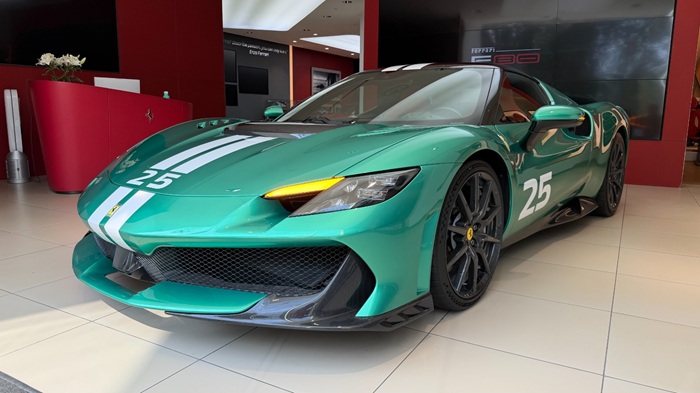
Built in the sacred grounds of Maranello, Italy, and penned by design maestro Flavio Manzoni—the same genius behind icons like LaFerrari and Daytona SP3—the 296 Speciale is essentially what happens when engineers are told, “Make it faster… now make it unreasonable.”
Visually, the car looks like it has been sculpted by wind itself. Every vent, duct, and contour screams purpose. Compared to the standard 296 GTB, this Speciale produces 20% more downforce and weighs 60 kg less, while packing an extra 50 horsepower. That’s Ferrari’s way of saying, “We weren’t done yet.”
The front fascia is a masterclass in aerodynamic aggression. Teardrop LED headlights, underbody “tea tray” aero elements, suspended splitter, and F80-inspired side ducts—all working together to glue the car to the road. Even the bonnet gets aero dampers because, apparently, normal bonnets are too boring.
Move to the side, and those massive air intakes look like they could inhale small hatchbacks. Carbon fibre skirts, Scuderia shields, and customizable racing numbers (yes, from 0 to 99—because personalization matters even at warp speed) add drama. At just 1.2 metres tall and weighing 1410 kg dry, with a 40:60 weight distribution, this thing is less “car” and more “guided missile with indicators.”
Then come the wheels—20-inch carbon fibre beauties wrapped in Michelin Pilot Sport Cup2 tyres that sound like they were developed in a Formula 1 paddock. Titanium wheel bolts, Brembo carbon ceramic brakes, and multiple colour options for calipers—because even stopping needs to look fast.
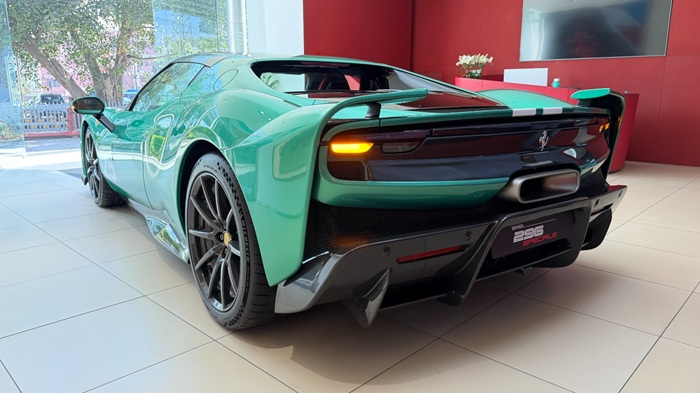
At the rear, things escalate quickly. A Kamm-tail design, massive carbon diffuser, vortex generators, and an active spoiler inspired by LaFerrari ensure that at 250 km/h, the car generates a staggering 435 kg of downforce. That’s not downforce—that’s gravitational commitment. The single central exhaust, inspired by Ferrari’s endurance racer Ferrari 499P, delivers a soundtrack that can probably be classified as emotional damage.
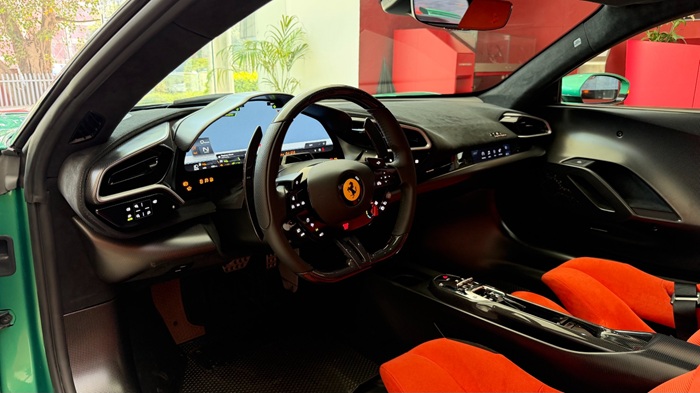
Step inside, and the cockpit feels like a spaceship designed by someone who hates distractions. Carbon fibre dominates, Alcantara wraps everything in racing intent, and the steering wheel looks like it belongs in a Formula 1 car—complete with LED shift lights and enough buttons to confuse a pilot. The interior echoes the futuristic setup of the Ferrari SF90 Stradale, but sharper, more focused, and less forgiving of casual driving.
You get a passenger display, wireless charging, Apple CarPlay, and even a 169-litre luggage space—because apparently, Ferrari believes you might want to go grocery shopping at 330 km/h. There’s also MyFerrari Connect, allowing you to track, monitor, and probably emotionally bond with your car via smartphone.
Now, let’s talk about the heart—or rather, the nuclear reactor—of this machine. A 3.0-litre twin-turbo V6, paired with a 7.45 kWh battery and electric motors, produces a combined 868 horsepower and 755 Nm torque. Yes, this is a plug-in hybrid. No, it does not care about your fuel efficiency expectations.
0–100 km/h happens in 2.8 seconds, 0–200 km/h in 7 seconds, and top speed is 330 km/h. In pure electric mode, it can go 25 km at up to 135 km/h—which is perfect for silently sneaking out of your neighbourhood before unleashing chaos.
Ferrari calls this engine the “piccolo V12”—a small V12 in spirit—and it borrows heavily from motorsport. Titanium connecting rods from Ferrari’s F80 program, Formula 1-derived knock control systems, and even trimmed engine block weight like the 499P race car. This isn’t engineering—it’s obsession.
Driving dynamics are where the Speciale truly earns its name. With Multimatic shocks from the 296 GT3, titanium springs, advanced ABS Evo, Ferrari Dynamic Enhancer 2.0, and a 6-way chassis sensor monitoring everything from velocity to driver ego, the car feels alive. The eManettino offers modes ranging from silent electric cruising to “Qualify,” which essentially means “good luck.”
And just when you think it can’t get any crazier, Ferrari throws in an “Extra Boost” mode derived from the Ferrari SF90 XX Stradale—a temporary power surge that feels like the car just had an espresso shot.
Safety hasn’t been ignored either. Four airbags, advanced traction systems, side slip control, electronic differential, and even a fire extinguisher—because Ferrari knows what you might do with 868 horsepower.
Despite all this madness, Ferrari still offers a 7-year maintenance program, because even legends need servicing every 20,000 km or once a year.
In the end, the Ferrari 296 Speciale is not just a car—it’s a statement. A statement that says performance is not enough, engineering must be extreme, and driving should feel like a controlled explosion of physics and passion.
It’s fast, it’s furious, and it’s unapologetically Ferrari.