
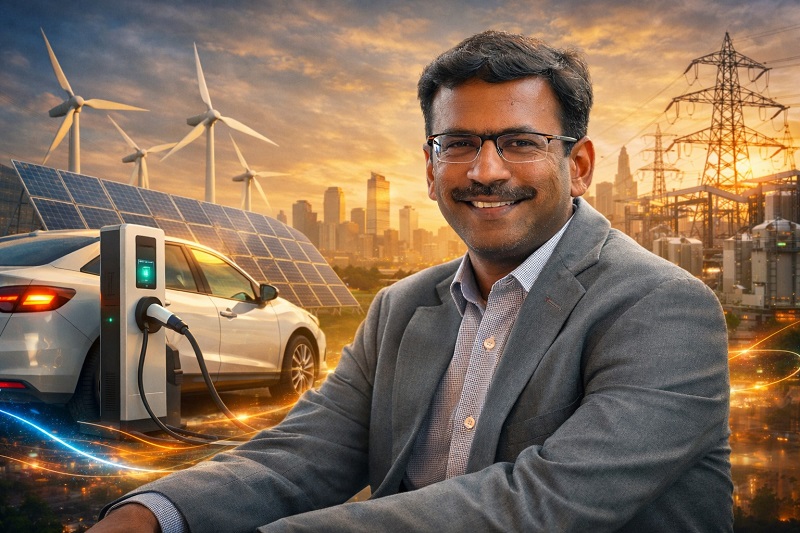
As India accelerates towards an electric mobility future, the spotlight is shifting from just vehicles to the power systems that support them. In this conversation with Vijayalayan R, India Head – Automotive Advisory at MathWorks, we explore how large-scale EV adoption will reshape the country’s electricity grid. From grid stability and smart charging to the promise of bidirectional charging and Vehicle-to-Grid (V2G) technologies, the interview unpacks the engineering, policy and digital intelligence driving the next phase of India’s clean-energy transition. At the heart of it lies a powerful idea: EVs are no longer just modes of transport, but emerging as active participants in India’s energy ecosystem.
1. EV Adoption & Grid Impact
- India is witnessing one of the fastest EV adoption curves globally. From your perspective, what are the biggest grid-stability challenges India will face as EV penetration accelerates, especially with millions of vehicles plugging in unpredictably?
India’s rapid EV adoption is exciting and it brings significant grid-stability challenges. When thousands of EVs plug in at the same time—say, during evening peaks—it can overload local feeders and transformers that were never designed for such dynamic loads. Voltage excursions and frequency deviations become more likely, especially in dense urban clusters. The solution is to treat EV charging as a controllable demand resource. Forecasting, optimization, and closed-loop control will be essential to flatten peaks, respect equipment limits, and maintain power quality. In short, intelligence in charging infrastructure will be as critical as the EVs themselves for India’s clean-energy future.
- With global forecasts predicting up to 50% higher electricity demand due to EV charging by 2050, where does India stand on preparedness? What lessons can we borrow from markets like the US or Europe?
India is in the early stages of this transition, but the foundation is forming. Smart city initiatives and rapid EV adoption are positive signs. Lessons from the US and Europe show the importance of early investment in grid visibility, standardized communication protocols, and incentives for smart charging. Pilots in Japan and Europe linked to renewables demonstrate that combining bidirectional charging with predictive algorithms can make EVs an asset rather than a liability for the grid.
2. Understanding Bidirectional Charging & V2G
- For a general audience, how would you explain bidirectional charging and Vehicle-to-Grid (V2G) in simple terms? Why is it often referred to as the “missing link” in large-scale EV integration?
Think of V2G as turning your EV into a two-way energy device. Normally, you charge your car or two wheeler from the grid. With bidirectional charging, your vehicle can also send power back when the grid needs it—like during peak demand. This flexibility is the ‘missing link’ because it transforms EVs from passive consumers into active participants in the energy ecosystem, helping to stabilize the grid and to integrate renewables.
- How do V2G-enabled EV batteries function as flexible storage assets, and what role can they realistically play in balancing supply–demand mismatches in India’s diverse grid?
V2G-enabled batteries act like distributed mini power plants. When demand spikes or renewable output dips, aggregated EVs can discharge energy back to the grid. In India, where solar and wind variability is high, this capability can help maintain frequency and voltage stability. It won’t replace large-scale storage overnight, but it can complement it—especially in urban areas with high EV density.
- In the Indian context—where renewables are growing rapidly—how can bidirectional charging help smoothen solar and wind intermittency?
Bidirectional charging allows EVs to absorb excess solar power that is generated during the day while they are charging and feed energy back to the grid during evening peaks. This time-shifting reduces curtailment of renewables and minimizes reliance on fossil-fuel plants. Combined with smart algorithms, V2G can orchestrate thousands of vehicles to act as a flexible buffer for India’s increasingly renewable-heavy grid.
3. The Engineering Behind V2G
- Bidirectional charging relies heavily on sophisticated power converters and control algorithms. Could you explain the underlying mechanisms that enable safe, efficient two-way power flow?
At the core of bidirectional charging is the power converter—a sophisticated system that acts as the bridge between the EV battery and the grid. This converter uses advanced power electronics to precisely regulate voltage and current, ensuring that energy can flow safely and efficiently in both directions. A digital control system governs the switching of components like transistors, enabling the converter to operate in all four quadrants—meaning it can manage both the direction of current and the polarity of voltage. This capability is what allows the EV to seamlessly transition between charging from the grid and discharging back into it. Engineers use simulation tools to design and test these converters, optimizing their performance for safety, efficiency, and compliance with grid standards before any physical hardware is built. The result is a reliable and intelligent system that supports dynamic energy exchange without compromising battery health or grid stability.
- What are some of the key engineering challenges in designing robust V2G systems—especially around safety, efficiency, battery degradation and communication protocols?
Safety and reliability are paramount. Engineers must design converters that meet grid codes, protect against faults, and prevent harmonic distortion. Battery degradation is another concern—frequent cycling can shorten life unless managed with smart algorithms. And because the EV ecosystem is fragmented, interoperability and secure communication protocols are critical to avoid vulnerabilities.
- How are engineers using simulation and Model-Based Design to build and validate bidirectional charging systems before hardware deployment?
Engineers use simulation and Model-Based Design to build and test bidirectional charging systems well before any hardware is developed. With MATLAB® and Simulink®, they can model batteries, converters, and grid interactions in detail, fine-tune control algorithms, and simulate fault conditions—all in a safe, repeatable environment. This helps ensure grid compliance and system reliability early in the process. Real-time testing, including hardware-in-the-loop setups, further reduces development risks and speeds up validation.
4. The Role of MathWorks Role & Its Engineering Tools
- MathWorks has been central to advancing Model-Based Design in automotive and energy systems. How do MATLAB and Simulink accelerate the development of V2G technologies for OEMs and grid operators?
Model-Based Design with MATLAB and Simulink helps OEMs and grid operators develop V2G technologies faster and with greater confidence. It allows teams to simulate the entire system—from power electronics to control logic—under real-world conditions, so they can optimize performance and ensure grid compliance before building hardware. Once the design is validated, engineers can automatically generate embedded code and test it in real time, which shortens development cycles and reduces costly rework. This integrated workflow is especially valuable for managing the complexity of bidirectional charging and ensuring safe, efficient two-way power flow.
- Could you share examples (without naming customers) of how Indian automotive or energy companies are leveraging advanced simulation, automated code generation, or real-time testing to develop next-gen bidirectional chargers?
Across India’s automotive and energy sectors, we’re seeing a growing number of companies adopt advanced simulation, automated code generation, and real-time testing to accelerate the development of bidirectional EV chargers. For instance, several OEMs and Tier-1 suppliers are using MATLAB and Simulink to model the entire charging system—from power electronics and control algorithms to grid interaction—before any hardware is built. This virtual prototyping allows them to validate grid compliance, optimize converter topologies like dual active bridges, and simulate fault conditions safely.
- For startups working on EV charging solutions, what pitfalls can be avoided by adopting early-stage virtual modelling?
Startups often face intense pressure to move fast, and that can lead to skipping early-stage simulation. Unfortunately, that shortcut usually results in costly redesigns later. Virtual modeling changes the game by letting teams validate critical aspects—like grid compliance, thermal performance, and battery aging—before a single piece of hardware is built. It’s not just about avoiding mistakes; it’s about accelerating innovation. With MATLAB and Simulink, engineers can explore multiple design options, run stress tests under extreme conditions, and fine-tune control algorithms in a safe, repeatable environment. This approach helps startups catch issues early, meet regulatory standards, and optimize performance without burning through time and capital. In a market where speed and reliability matter, simulation and Model-Based Design give young companies the confidence to launch robust solutions on their first try.
5. Future of V2G in India
- What policy or regulatory enablers are essential for large-scale V2G deployment in India—tariff structures, data standards, incentives?
Even the best technology will struggle to scale if we don’t have the right regulatory enablers. This is more important for a country like India as the interoperability standards and tariff structures are still evolving.
Clear tariff structures based on time of use incentivizing EV owners are essential.
- How soon do you foresee mainstream EVs in India offering factory-ready bidirectional charging, and what might that mean for consumers, DISCOMs, and OEMs?
This new technology is building momentum in India. One such example is the Kerala State Electricity Board (KSEB) exploring a collaboration with the Indian Institute of Technology – Bombay (IIT Bombay) as part of its efforts to integrate vehicle-to-grid (V2G) technology into the Kerala power system.
In addition to a favourable regulatory environment and incentives to help early adoption, there needs to be collaboration between industry and utility players like DISCOMs to make this technology accessible.
- Globally, V2G is also enabling “vehicle-to-home” (V2H) and “vehicle-to-building” (V2B) use cases. Which of these do you think could scale fastest in India?
Most of the vehicles are charged at Indian homes. V2H will likely scale first because it aligns with consumer needs for backup power during outages and in some way aligns to the individual’s needs. V2B will need commercial fleets, and smart buildings look towards adopting models where they start seeing benefits in leveraging this technology.
6. Personal & Industry Vision
- As an IIT Madras alumnus and a seasoned control engineer, how do you see the convergence of automotive engineering, energy systems, and digital simulation shaping India’s next decade?
India’s next decade will be shaped by the convergence of automotive engineering, energy systems, and digital simulation. Vehicles are evolving from hardware-centric to software-defined platforms, where algorithms and embedded intelligence drive adaptability. Artificial Intelligence is now integrated from the earliest stages, requiring multidisciplinary teams to align control strategies, processors, and architectures with business goals.
Control systems themselves are transforming—moving beyond classical feedback loops to adaptive, predictive, and AI-enabled architectures. Trends like automated driving, electrification, and vehicle-to-grid integration demand real-time decision-making, sensor fusion, and robust safety algorithms.
Equally transformative is the rise of simulation-led workflows and model-based design, combining data-driven insights with physics-based models to validate vehicle dynamics and grid interaction before hardware exists—reducing cost and risk.
This fusion of intelligence positions India to lead in grid-aware mobility, delivering cleaner transportation, resilient energy systems, and globally competitive solutions engineered in software and proven in simulation.
- What excites you the most about the future of smart charging and grid-interactive EVs?
What excites me most is the transformation of EVs from passive energy consumers into active grid assets. Smart charging and vehicle-to-grid (V2G) technologies will enable EVs to stabilize the grid, absorb surplus renewable energy, and even supply power during peak demand—creating a dynamic energy ecosystem where mobility and electricity work in harmony.
For engineers, this opens up thrilling opportunities:
- Power electronics engineers will design bidirectional converters that are efficient, compact, and reliable under varying grid conditions.
- Automotive engineers will integrate these systems seamlessly into vehicles while ensuring safety, thermal management, and compliance with evolving standards.
The challenges are equally compelling: balancing battery health, charging speed, and grid constraints in real time, while maintaining cybersecurity and interoperability across millions of vehicles. AI-driven forecasting and adaptive control algorithms will be key to making charging predictive rather than reactive.
Ultimately, smart charging is about orchestrating EVs as distributed energy resources—accelerating India’s clean energy transition and creating a new frontier for innovation in both mobility and power systems.
- Finally, what advice would you give to young engineers entering the EV and clean-energy domain, particularly those aspiring to work in system modelling or control design?
My advice is simple: master the fundamentals, embrace systems thinking, and stay adaptable. Control design and system modeling are at the heart of EVs and clean-energy solutions, but these systems are no longer isolated—they are multidomain and interconnected.
Start with a strong foundation in control theory, power electronics, and dynamic systems. These principles remain the backbone of advanced algorithms. Next, learn model-based and simulation-led development using tools like MATLAB and Simulink, digital twins, and hardware-in-the-loop (HIL) testing. These workflows reduce risk and accelerate innovation—skills that key industries like automotive, aerospace, industrial automation and machinery and electric & utilities value highly.
Equally important is systems thinking: a framework for seeing interrelationships rather than things, for spotting patterns of change rather than static snapshots. This mindset helps you design solutions that scale and adapt in complex ecosystems.
Finally, combine hard skills (optimization, embedded systems, AI integration) with soft skills (collaboration, communication). Student competitions and hackathons are excellent platforms for this—they simulate real-world challenges, foster teamwork, and encourage creative problem-solving under constraints. The future is bright and exciting for engineers who unite physics-based rigor with data-driven intelligence to create sustainable, safe, and efficient technologies.