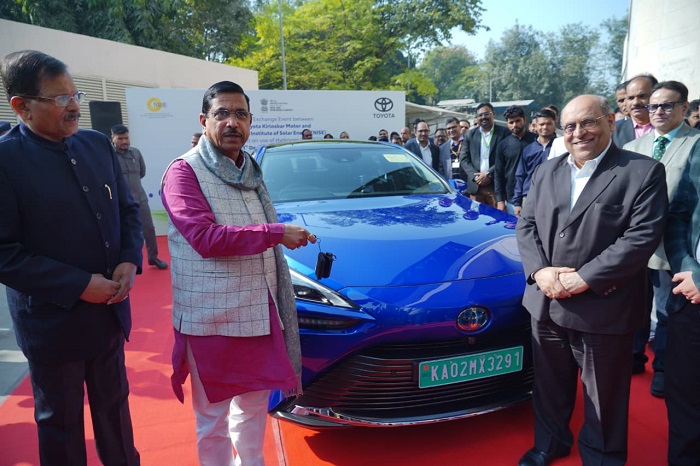
New Delhi — In a move that could very well shift India’s clean mobility story from “concept stage” to “action thriller,” Toyota Kirloskar Motor (TKM) today exchanged a Memorandum of Understanding with the National Institute of Solar Energy (NISE) under the Ministry of New and Renewable Energy (MNRE). The ceremony, held at MNRE headquarters, came with both gravitas and optimism — the kind that usually accompanies big national missions or the launch of a new blockbuster SUV.
The star of the day? The Toyota Mirai — a hydrogen fuel-cell electric vehicle so clean it emits only water vapour, making it possibly the only car in India that could, in theory, help water plants if it tried hard enough.
Hydrogen on the Highway: India Begins Real-World Trials
As part of the agreement, Toyota handed over the Mirai to NISE for extensive real-world performance evaluation under Indian driving and climatic conditions. And by Indian conditions, they mean everything — from Delhi’s traffic snarl-ups and Rajasthan’s dust storms to Bengaluru’s surprise rains and Ladakh’s thin air.
The study will examine fuel efficiency, driving behaviour, real-world range, refuelling characteristics, terrain adaptability, winter performance, and how well the car handles the national pastime: bumper-to-bumper commuting.
This marks a major step forward for India’s National Green Hydrogen Mission, as policymakers, researchers, and industry leaders collectively explore how hydrogen-powered mobility can support the country’s march toward carbon neutrality and energy independence.
Leaders Express Optimism — and a Clear Warning to Carbon
Shri Pralhad Joshi, Hon’ble Union Cabinet Minister of New and Renewable Energy and Consumer Affairs, Food & Public Distribution, graced the occasion and described the partnership as a decisive leap toward cleaner energy.
“India’s shift to clean energy is now moving from planning to implementation,” he said. “This MoU and the handover of the Mirai are critical steps for our National Green Hydrogen Mission. Such collaborations build domestic capacity and bring us closer to energy independence.”
Translation: The era of fossil-fuel dominance might want to start packing its bags.
From TKM’s side, Sudeep Dalvi, Chief Communication Officer & Senior Vice President, highlighted how the Mirai’s testing will generate critical insights for hydrogen-powered mobility in India’s uniquely challenging environment.
Vikram Gulati, Country Head & Executive Vice President, reiterated Toyota’s multi-pathway strategy that integrates hydrogen fuel-cell EVs, battery EVs, strong hybrids, and alternative fuels — essentially saying, “Why choose one green solution when you can choose all of them?”
Toyota Mirai: Zero Emissions, 650 km Range, and a 5-Minute Refuel
The second-generation Toyota Mirai has long been one of the world’s most advanced fuel-cell electric vehicles, capable of delivering:
- Around 650 km of driving range
- Near-instant torque from its electric motor
- Refuelling in under five minutes
- And of course, emitting only water vapour
In other words, it’s a firm reminder that the future of mobility can be clean, high-tech, and surprisingly convenient.
Powering India’s Net-Zero Vision
This collaboration fits squarely within India’s fast-evolving hydrogen policy ecosystem. As the country works toward its 2070 net-zero commitments and 2047 energy-independence targets, hydrogen mobility is expected to play a pivotal role alongside renewable energy, EVs, storage, and hybrid technologies.
For Toyota, the partnership reaffirms its commitment to achieving carbon neutrality by 2050 across the product lifecycle — from manufacturing to driving to future recycling — all powered by circular economy principles, renewable energy, and water stewardship.
India has taken another concrete step toward a hydrogen-powered future. Toyota has handed over one of the world’s most advanced clean-mobility vehicles to India’s premier solar research institute. And if all goes well, the Mirai may soon prove that hydrogen isn’t just the fuel of the future — it might be the best companion for India’s roads today.
Also, if someday you spot a blue Toyota quietly sipping hydrogen and emitting nothing but water mist on the highway — don’t worry, it’s just science doing its thing.