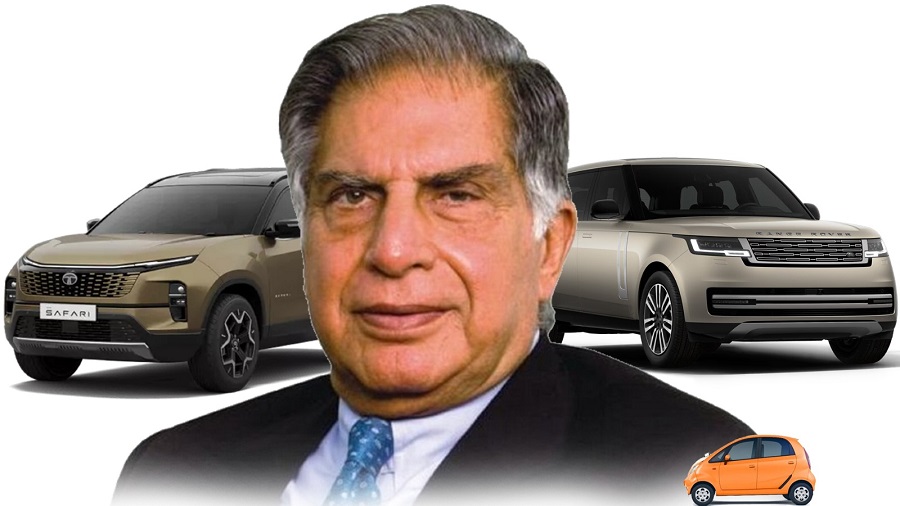
It’s been one year since India bid farewell to one of its most respected sons — Ratan Naval Tata — yet his name continues to echo through every lane where a Tata Nano once hummed, every skyline graced by a Taj Hotel, and every heart that still believes business can indeed be done with kindness.
A man of few words but infinite impact, Ratan Tata was not just an industrialist — he was the nation’s moral compass on four wheels (and occasionally, four paws). He led the Tata Group from 1991 to 2012, briefly returning as interim chairman in 2016, just to ensure the engines of ethics never idled. Under his watch, Tata’s revenues grew 40 times and profits 50 times, proving that good guys don’t always finish last — sometimes, they finish with Jaguar Land Rover in their garage.
A Vision Beyond Balance Sheets
Ratan Tata’s vision went beyond steel, salt, and software. He turned an Indian conglomerate into a global force, with over 65% of its revenues coming from international markets. When others were still thinking of exports, Tata was busy importing respect — acquiring Tetley, Corus, and Jaguar Land Rover like a man collecting world-class stamps, only heavier and more expensive.
His masterstroke came with the Tata Nano, a car that promised to put India on wheels — quite literally. Critics called it “the people’s car.” Ratan Tata called it “a promise kept.” It wasn’t about luxury; it was about accessibility — and he did it without the usual corporate jazz hands, just pure intent and engineering grit.
From Adversity to Audacity
Not many remember that in 1999, Tata Motors almost sold its passenger car division to Ford — until Bill Ford, mid-negotiation, politely made him realize who the real visionary in the room was. Nearly a decade later, as Ford hit financial potholes, Ratan Tata returned — not with revenge, but with an offer: to buy Jaguar Land Rover. Bill Ford’s words? “You’re doing us a big favour.” Indeed. The rest is automotive poetry.
From Daewoo’s truck plant in Korea to Italy’s Trilix design studio, Tata’s acquisitions weren’t about empire-building — they were about learning, blending, and proving that Indian engineering could roar louder than anyone else’s.
A Humanitarian in a Business Suit
Ratan Tata’s generosity wasn’t limited to foundations and scholarships — it was deeply human. After the 1984 Anti-Sikh riots, he donated trucks to Sikh drivers who had lost their livelihoods, rebuilding lives with steel and compassion. To this day, many Sikh transporters swear by Tata trucks — not just for mileage, but for memory.
He championed animal welfare, supported education, and was often spotted with his rescue dogs at Bombay House — where the boardroom decisions were probably approved with a tail wag.
The Legacy That Lives On
From the Tata Institute of Social Sciences to Tata Memorial Hospital, and from Tata Power’s green vision to Tata Motors’ electric revolution, Ratan Tata’s spirit continues to electrify India — quietly, humbly, efficiently.
He didn’t need to shout about success — he simply lived it. And in a corporate world that often confuses noise for leadership, he stood out by speaking softly and building boldly.
As India remembers him today, perhaps the greatest tribute isn’t a monument or a museum — it’s every Indian entrepreneur who still believes you can build an empire without losing your soul.
In his own understated words:
“I don’t believe in taking right decisions. I take decisions and then make them right.”
That, dear India, was Ratan Tata — the man who made even humility look powerful.